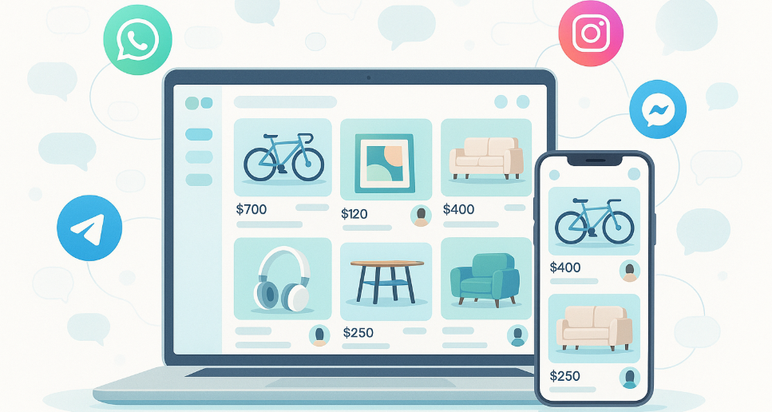
Feasibility Study: Peer-to-Peer Marketplace Platform in Syria with Omni-Channel Chat Integration
1. Market Analysis & Trends
Global P2P Marketplace Trends: Peer-to-peer (P2P) marketplaces remain a robust and growing segment of e-commerce in 2025, not a fading trend. In fact, global P2P marketplace revenues are rising – the market is projected to reach around $5.1 billion by 2032 (up from about $1.08 billion in 2021), with an annual growth rate over 15%. This growth is fueled by continued consumer interest in secondhand goods, sharing economies, and direct trade, as well as brands looking to do more with less by leveraging resale and customer-to-customer channels (the “recommerce” boom). Far from being outdated, the P2P model is expanding into new niches (fashion resale, peer services, etc.) and remains competitive in the digital economy of 2025. Major players (e.g. eBay, Facebook Marketplace, niche apps like Vinted or Depop) are still thriving, and new P2P platforms emerge targeting specific communities. All this indicates that launching a P2P marketplace in a new market is conceptually sound – the model is proven and not obsolete.
Emerging Markets & Regional Context: In emerging markets, online marketplace adoption has been growing steadily, albeit from a small base. Key drivers include increasing internet and smartphone penetration, a youthful population comfortable with mobile apps, and the need for affordable goods (which P2P used-goods marketplaces supply). MENA Region: E-commerce in MENA is on a sharp rise, projected to reach $50 billion by 2028. Social media and informal selling (Instagram, WhatsApp groups) are popular, which P2P apps can formalize. Syria’s Case: Syria’s digital market is in a nascent stage but evolving. As of 2021, roughly 8.5 million Syrians (47% of the population) were internet users, up 15% from the year prior. Social media usage is high (7.6 million users in 2021), hinting at a growing comfort with online platforms. However, formal e-commerce is still very limited: a 2025 report counted only 146 e-commerce stores in Syria in total, most of which have very low sales and traffic. The vast majority of these stores see <100 visitors a month, and virtually all make under $100 in monthly sales. These numbers highlight both the challenge (low current adoption) and the opportunity (a largely untapped market with minimal competition in organized e-commerce).
Marketplace Relevance in 2025: Importantly, P2P marketplaces align with some rising global trends in 2025: sustainability and thrift (people selling used items, reducing waste), and the quest for affordable alternatives amid economic pressures. In many regions, P2P platforms are expanding in popularity because they enable recommerce and local entrepreneurship. There is also a trend of integrating marketplaces into “super-apps” or existing platforms. Facebook, for instance, pushes Marketplace globally; messaging apps like WhatsApp introduced features for business catalogs. This underscores that communication-rich commerce is a winning formula. A marketplace that combines listing functionality with seamless chat taps into this trend of social-commerce convergence.
Impact of Integrated Chat: Integrated real-time chat is increasingly seen as a key driver for engagement and trust in marketplaces. Studies show that live chat or messaging features can significantly boost conversion rates – by as much as 20% on average – by quickly addressing buyer questions and hesitations. Marketplaces embedding chat have higher user retention and transaction completion, as users appreciate the immediacy (83% of consumers expect to interact with someone instantly when shopping online). In 2025, more platforms are adopting omni-channel messaging, letting users communicate via their preferred channels. This suggests that our strategy to integrate an omni-channel solution (ClefinCode Chat) is on-point with current trends. It leverages the fact that users are comfortable on apps like WhatsApp/Messenger and uses that to drive marketplace interactions. Overall, marketplace platforms are not declining; if anything, they are evolving – and a Syria-focused marketplace with modern features fits into the continued relevance of P2P commerce today.
Competitiveness of the Model: Is a peer-to-peer buy/sell platform still competitive in 2025? Yes. While the basic concept has been around since eBay’s launch in 1995, it’s continually reinvented. Newer apps focus on mobile-first experience, integrated payments, and social features. Our proposed platform, by integrating omni-channel chat and offering escrow/logistics, is actually aligning with the cutting edge of P2P marketplaces. In a market like Syria that is behind the curve, introducing a state-of-the-art platform could leapfrog older models. Rather than the model being outdated, the lack of such a platform in Syria means we can be first to bring a competitive, modern solution. The key will be execution: adapting to local needs (detailed below) so that global trends meet Syrian reality effectively.
2. Target Audience and User Behavior
Ideal User Profile (Syria): The target users in Syria would likely skew toward younger, tech-savvy individuals – for example, ages ~18-40 – since this demographic has higher internet and smartphone usage. Many young Syrians have Android phones and actively use social media or messaging apps daily. Urban areas (Damascus, Aleppo, Latakia, Homs) would have the highest concentration of such users, including college students, young professionals, and small business owners. Income levels in Syria vary widely due to economic turmoil, but a common thread is price sensitivity – people are looking for deals. Thus, middle-class individuals seeking affordable second-hand goods (furniture, phones, clothing) or trying to earn extra cash by selling items would form a core user base. Moreover, given high unemployment, entrepreneurial users (e.g. someone who buys and flips used electronics for profit) may also engage heavily. In similar emerging markets, we often see youths driving marketplace adoption, then gradually older age groups follow once trust is established.
Tech Adoption & Connectivity: Internet access in Syria, while not universal, has been rising. By 2025, possibly more than half the population is online (up from 47% in 2021). Smartphones (particularly Android devices) are common even in lower-income groups, as Chinese and used handsets are available. However, connection reliability can be an issue (due to electricity outages and infrastructure). The platform must be mobile-optimized and work on low-bandwidth conditions. The average user is familiar with basic apps but perhaps not with online shopping apps (since e-commerce is new culturally). This means the UI should be simple and intuitive, and onboarding should educate users on how to use the marketplace safely.
Consumer Trust Challenges: Trust is the critical barrier. In Syria, online transactions are a new concept for many, and scams or fraud fears are high. Culturally, many Syrians prefer in-person dealings where they can see the item and judge the seller. There’s also wariness because consumer protection is weak – if a deal goes bad, there’s little legal recourse. Specifically, challenges include: fear of counterfeit or broken products, concern that a seller or buyer might not show up or might swindle money, and general skepticism of “online promises.” Additionally, after years of crisis, people may have trust issues with new services (people stick to known community networks). Overcoming this requires building credibility and a sense of safety on the platform.
Role of Integrated Chat in Building Trust: ClefinCode Chat’s integration can directly address some trust issues:
- Direct Communication: Allowing buyers and sellers to talk in real time humanizes the experience. Instead of a faceless listing, the buyer is chatting with a real person. This open dialogue fosters understanding and can clear up ambiguities. For example, a buyer can ask, “Does the phone have any scratches?” and get immediate answers or photos. This transparency can prevent misunderstandings and make both sides more comfortable proceeding.
- Instant Verification: Through chat, users can share additional photos or even videos on the fly. According to marketplace best practices, the ability to share rich media in chat is crucial for confidence. A seller can send a quick picture of the item’s receipt or a short video showing the item working. This real-time verification builds trust far better than a static description.
- Building Personal Rapport: Culturally, Syrians are used to bargaining and chatting when doing business (think of the haggling in bazaars). The chat gives a taste of that personal interaction – polite greetings, maybe a bit of negotiation banter – which can increase comfort. Seeing a responsive, polite chat response from a seller makes the buyer feel the seller is genuine. As one analysis notes, humanizing the transaction via chat reduces psychological distance between strangers, thus improving trust.
- Record & Accountability: Unlike a phone call or an ephemeral chat on a personal WhatsApp, the integrated chat (especially if logged) creates a record of promises. If a seller says in chat “Yes, it’s brand new, I never used it,” that’s documented. Knowing that communications are recorded (and users are aware of this in terms) can deter outright lies or malicious behavior. It also means if something goes wrong, the platform’s support can review what was said. This offers a form of accountability that is new in an informal market – effectively acting as a trust guarantor. Users may feel safer knowing there’s proof of what was agreed upon (e.g., agreed price, condition).
- Omni-Channel Convenience: Many Syrian users already rely on WhatsApp or Facebook Messenger to communicate, including for informal buying/selling via groups or friends. ClefinCode Chat’s omni-channel ability means users can stick to their preferred communication channel while still using the platform. For instance, a buyer could initiate contact through the marketplace and then choose to receive replies on WhatsApp – the conversation is synced to the platform. This is powerful because if users don’t have to change their habits (e.g., constantly check a new app for messages), they are more likely to engage promptly. Faster responses = faster transactions = more trust. It leverages WhatsApp’s ubiquity without losing visibility (since the chat is captured by the platform as well).
In summary, integrated chat acts as both the glue that brings the community feel to the marketplace and the oil that smooths the transaction process. It directly tackles the trust deficit by enabling communication, verification, and accountability.
Communication Channel Preferences: It cannot be overstated that WhatsApp is king in Syria. It is the most popular messaging app nationally, used widely for everyday communication, sharing news, and also business dealings. Following WhatsApp, Facebook Messenger is also common, given Facebook’s large user base in Syria. Telegram and Viber have some usage (Telegram in particular saw uptake during conflict times for news and expat communication), but likely WhatsApp dominates personal transactions. Any solution that integrates WhatsApp seamlessly will resonate with Syrian users. This means, for example, using WhatsApp notifications or chat relays for marketplace messages will align with user habits (people check WhatsApp frequently, whereas a standalone app might be forgotten without notifications).
The dominance of these apps implies users expect quick, chat-based interactions. Phone calls are used too, but among younger users, messaging is often preferred (and more practical for record-keeping). Our platform should thus encourage chat first, but possibly allow escalation to voice call or even in-person meeting arrangement via chat. Since ClefinCode Chat can unify channels, a user might even start chatting in-app and then continue on, say, Messenger if they find that easier – the key is giving that flexibility.
Payment Preferences & Habits: In Syria, cash is king. Years of war and sanctions have limited electronic payment infrastructure. Most people do not have internationally accepted credit cards, and local debit card usage is low outside certain government payments. Cash-on-Delivery (COD) is the norm for the few e-commerce operations that exist, and in peer transactions it’s usually cash in hand upon meeting. Surveys and expert opinions note that despite pushes for e-payments, “the common behavior will continue to be cash payments” for the foreseeable future. Reasons include lack of trust in banking, hyperinflation (people don’t want money stuck in bank accounts losing value), and simply habit – cash is tangible and universally accepted.
For our platform, this means we must accommodate cash transactions to align with user comfort. Initially, we expect many users will use the platform to find a buyer/seller, then meet in person to exchange cash and goods. We should design for that (having a workflow to mark deals as completed, possibly exchanging a code or confirmation via the app post-meetup).
That said, digital payment interest may grow gradually, especially if the platform itself offers an escrow that feels safer. Younger users and those who are a bit more tech-forward might be open to using a wallet or payment app if it’s convenient and trusted. But since trust is low, a sensible approach is: start with COD and cash as primary, and build in digital payment as an optional, value-added feature. For example, someone could choose to pay through the platform (if we introduce a wallet/escrow) for added protection – but they don’t have to.
Transactions & Communication Alignment: Given these preferences, the platform’s design should link communication to transaction steps. For instance:
- A buyer sees an item and starts a chat (in-app or via WhatsApp integration) to inquire. They negotiate price and details through messages.
- Once they agree, the buyer and seller might decide on a meet-up (if local). They can share location or pick a known spot via chat. The platform could integrate a map or at least allow sending a pinned location in the chat.
- After meeting and exchanging cash/item, one of them (or automatically) can mark the deal as completed in the app. Ideally, the app can prompt: “Mark this item as sold?” which not only updates listing status but could trigger a “leave a review” prompt where they rate each other. This closes the loop and feeds into building trust for future users.
- If using the platform’s payment service (in the future), the chat could facilitate that: a “Pay Now” button in chat when they agree on a price, which then confirms to both that money is in escrow. Post-delivery, the buyer can confirm in chat and the platform releases funds.
User Behavior Nuances: It’s worth noting that Syrian users might initially use the platform in a semi-informal way – for example, listing items but then immediately trying to move the conversation off-platform (“Call me at this number”). Many will be used to Facebook groups where they share phone numbers. We want to encourage them to stay within the app/chat for their own safety (so that everything is logged and protected by our system). This might require education: e.g., tips like “For your safety, use our in-app chat instead of taking conversations offline – that way you have a record and our support can help if needed.” As trust builds, users will increasingly conduct full transactions within the ecosystem.
In conclusion, our ideal users are there and the demand (need for a convenient, trustworthy way to buy/sell used goods) is likely strong due to economic conditions. The key hurdle is behavioral – building trust in a new platform. By aligning with existing behaviors (heavy WhatsApp use, preference for personal interaction and COD) and gently guiding them to safer, better practices (using logged chat, considering escrow), we can adapt to and gradually shape user behavior in Syria’s context.
3. Competition Analysis
Launching a P2P marketplace in Syria means going up against a mix of informal channels and a few nascent formal competitors. Below is an overview of the competitive landscape:
Local Online Platforms (Current Direct Competitors):
- Asuaaq (أسواق) – A dedicated Syrian marketplace app/website (launched in recent years). Asuaaq positions itself as a general classifieds platform for Syria, covering categories like cars, real estate, electronics, furniture, jobs, etc.. It emphasizes direct transactions without intermediaries, essentially functioning like a Craigslist/Gumtree for Syria. Key features based on its description include: the ability for users to list items with images and descriptions, browse by category with filters, and crucially, a community interaction aspect. Asuaaq explicitly encourages buyers and sellers to interact, ask questions, and negotiate terms directly, fostering a community feel. It claims to have no commissions or brokerage fees, making it free to use and thereby attractive in a cost-sensitive market[1]. Security is mentioned in general terms (guidelines for safe trading), but it does not act as an intermediary in payments. Asuaaq having updated versions as of mid-2025 shows it’s active; however, its scale seems modest (the app had about 4,000+ downloads on Aptoide, and 1.5K on a recent version). Competitive gap/opportunity: Asuaaq has recognized the importance of direct chat between users (“real-time responses” are touted), validating our emphasis on communication. However, it likely uses a simple in-app chat or even just phone contact – there’s no indication of an omni-channel integration. Also, being newer, it may not yet have achieved critical mass. Our platform can learn from Asuaaq’s approach (broad categories, no fees early on) but differentiate by offering a superior messaging experience (multi-channel, richer features) and potentially better trust tools (like verified sellers or transaction support).
- Syria Shop (by Al-Malik) – Another mobile app (on Google Play) aimed at Syrian online classifieds. Syria Shop markets itself as “one of the largest and most diverse applications in the Syrian market”, providing a safe and easy environment for buying and selling. Feature-wise, it highlights: a smooth user interface, neatly categorized listings (cars, homes, electronics, etc.), direct interaction via text messages or phone calls between buyers and sellers, free ad posting, and a ratings/comments system for users. It also stresses security and privacy, saying all transactions are protected with the latest security tech (though this may refer to general data security rather than payment protection). Syria Shop essentially is building a similar solution: free listings, user-to-user contact, and a reputation system. It was updated in Mar 2025, suggesting active development. However, its download count was only 100+ on Google Play, implying it’s very early-stage or not widely adopted yet. Competitive gap: Syria Shop has a ratings system, which is important for trust. We will want to implement a similar reputation mechanism. Its communication is via in-app text or phone; again, no evidence of multi-channel integration. Also, Syria Shop being new and small means the field is still open – no single Syrian platform has locked in users by network effects yet.
- Other Local Apps: A search also revealed an app called “Asuaaq” (likely same as Asuaaq above) and perhaps other minor ones. It’s possible there are Facebook-based startups or lesser-known apps trying their hand. For example, some Facebook pages or groups mimic OLX-style posting. So far, none have mainstream dominance.
Regional/Global Platforms used in Syria:
- OpenSooq (opensooq.com) – OpenSooq is a major horizontal classifieds platform across the Arab world (originating from Jordan). It does operate in Syria via a subdomain (sy.opensooq.com) and is already a go-to site especially for certain categories. In fact, in the real estate segment, OpenSooq “seems to be where Syrians go to buy and sell property in the absence of OLX”. It likely has sections for vehicles, electronics, services, etc., making it a direct competitor on content. OpenSooq’s strengths: strong brand recognition in MENA, a high volume of listings (because it aggregates many countries, though Syria-specific content depends on local users), and a proven platform architecture. It also has an app with chat functionality (OpenSooq does include in-app messaging and calls anonymization in some markets). Competitive gap: While OpenSooq is present, Syria might not be a primary focus market for them (given limited monetization potential under sanctions until recently). Their product might not be fully localized to Syrian needs (e.g., they might list prices in USD or in Syrian Pound without handling inflation well, etc.). Also, OpenSooq wouldn’t offer an omni-channel chat – at best it’s standard in-app messaging. We can differentiate by deeply localizing our platform (language dialect, local city filters) and emphasizing trust/safety in a way a big generic platform might not (e.g., verifying local users or integrating with local services). Essentially, we can out-service OpenSooq in Syria through localization and features like ClefinCode Chat that OpenSooq doesn’t have.
- Facebook Marketplace & Social Media: Facebook is widely used in Syria, and Marketplace is available (though Facebook’s user experience in Syria might be hindered by periodic connectivity issues or account restrictions). Many Syrians also conduct commerce on Facebook Groups – for example, city-based buy/sell groups or specialty groups (for cars, etc.). This is a form of competition because it’s an existing way to do P2P sales. Facebook Marketplace has the advantage of leveraging social graphs (you can sometimes see a seller’s profile, mutual friends, etc., which can inspire trust). It also uses Facebook Messenger for communication, which is convenient. However, Facebook lacks certain marketplace-specific features (no escrow, no formal moderation beyond user reports, and no special integration of WhatsApp which is more popular than Messenger there). Competitive gap: Our platform can attract users by offering a more structured and safer environment than informal Facebook deals. For example, we can highlight ratings/reviews, verified accounts, and escrow options – things Facebook doesn’t provide. Also, by integrating WhatsApp, we bridge the gap that Facebook Marketplace has (Facebook primarily pushes Messenger which is #2 to WhatsApp in Syria). Essentially, we aim to combine the reach of social media with the functionality of a dedicated marketplace. Convincing people to move from Facebook groups to our app will require showing that it’s just as easy but far more secure and effective.
- Informal Channels (Offline or Peer Networks): The biggest “competitor” is the status quo: people selling to those they know or via local shops. In Syria, physical bazaar markets for used goods (e.g., electronics souks or car fairs) are common. And given trust issues, many prefer dealing through a friend-of-a-friend. Additionally, WhatsApp groups have become a way to sell things – e.g., someone might post “I’m selling a couch” in a community group. These aren’t formal platforms, but they soak up the market demand. Our aim is to capture these informal transactions into our platform by offering an experience nearly as straightforward but adding value (wider reach, better trust). The integration of ClefinCode Chat actually helps mimic the informal style (people feel like they’re just messaging on WhatsApp, which they do anyway) while funneling the activity through a platform that can provide oversight and features.
Competitive Differentiators – ClefinCode Chat Integration:
One of our unique selling propositions is the omni-channel chat. Let’s consider how this stands out:
- None of the identified competitors offer a truly unified messaging solution across apps. At best, they have in-app chat or allow phone calls. Our platform would let a user communicate on their terms (WhatsApp/Messenger/etc.) while logging the conversation. This is a major convenience boost and could be heavily advertised (“Chat with buyers through WhatsApp without giving out your number – our app keeps it secure and in sync”). This not only leverages user habits but also addresses a privacy concern: people might not want to share their personal phone number publicly. With our system, initial contact can be made through the platform’s channel, protecting privacy but still using WhatsApp’s familiarity.
- Secure Negotiations & Proof: Because our chat is logged and tied to user accounts, it provides a built-in proof mechanism. For example, if a user claims “the seller promised in chat to include extra accessories,” we can check that. Competitors like Facebook or OpenSooq won’t step in to mediate disputes with chat logs – they simply don’t offer that service. We can differentiate by saying dispute resolution is supported by chat transcripts, giving users confidence that if something goes wrong, they’re not alone. This is akin to how Airbnb uses its messaging – they encourage all communication to stay on the platform precisely so they can resolve issues if needed with a clear record.
- Trust Signals: We could incorporate chat activity into trust signals. For instance, show on a seller’s profile “Avg. response time: 1 hour” or “Chats responded to: 95%” – indicators like these (commonly seen on e-commerce marketplaces like Etsy or Shopee) encourage buyer confidence that the seller is active and responsive. This level of detail isn’t provided by simpler classified platforms.
- Automation & Integration: With omni-channel chat, we can integrate automated messages: e.g., a WhatsApp confirmation to the buyer (“You agreed to buy item X. Click here to see pickup details or use our delivery service.”). This kind of integration between transaction flow and messaging is an advanced feature competitors lack.
Other Potential Competitors: It’s worth considering if OLX (the global classifieds brand) has any presence. OLX was active in some Middle Eastern countries (they had OLX Jordan, OLX Lebanon at one point). There isn’t an official OLX Syria due to the conflict and sanctions, but they could eye it if the situation normalizes. Also, Dubai-based and regional marketplaces like Dubizzle (OLX’s cousin) or Haraj (popular in KSA) aren’t in Syria, but could be indirect competition if Syrians use neighboring platforms. Souq.com/Amazon – Amazon’s presence in Syria is nonexistent due to sanctions, so no direct competition from major e-commerce giants yet.
Identified Gaps and Strategy:
- Trust and Safety: Local competitors are still building trust features (Syria Shop’s rating system is a start). None offer escrow or verified IDs. This is a gap we can fill decisively by implementing escrow payments, verified badges, and robust user review systems, backed by our chat records. Becoming known as “the safest way to buy/sell online in Syria” would differentiate us strongly.
- Payment & Logistics Integration: No competitor likely offers integrated payment or delivery. OpenSooq and others usually leave it to users to figure out. By potentially offering in-app payment (even if COD or escrow) and optional delivery partnerships, we create a more end-to-end solution. This “full-stack” approach (like how rideshare apps integrated maps, payments, etc., instead of leaving anything to the user) could leapfrog competitors.
- Focus on Omni-Channel Communication: We should market that unlike a plain listing site, our platform is a communication hub for transactions. This means better responsiveness and less friction in deal-making. A buyer on our app doesn’t have to wait days for an email reply – they get a ping on WhatsApp immediately. This responsiveness is crucial in making successful sales (many sales are lost when communications lag).
- Local Presence and Community: We can cultivate a community vibe (perhaps via moderated forums or social media engagement) that a generic platform like OpenSooq cannot. For example, run promotions like “Seller of the Week” in Syria, share success stories (“X sold his bike in 2 hours on our app!”). Building that local community rapport can set us apart from larger but impersonal platforms.
In summary, competition in Syria is present but not formidable. The market is still largely underserved by modern marketplace solutions. Our main direct competitors are early-stage local apps focusing on free classifieds. We can outcompete them by being first to offer advanced features (omni-channel chat, escrow, AI moderation) and by pushing hard on trust/safety differentiators. Indirectly, we compete with the established habit of informal trade (Facebook, WhatsApp, offline) – but here our strategy is to mimic the convenience of those channels (through integration) while adding structure and security. If executed well, we have the opportunity to become the leading marketplace platform in Syria, as none has secured that title yet. We just must move quickly to establish our brand before others catch up, and always emphasize what makes us different (and better) for users.
4. Monetization and Business Model
Building a sustainable business model in an emerging market like Syria requires flexibility and creativity. Traditional e-commerce monetization strategies must be adapted to the local context of low trust and limited digital payments. Below, we examine potential revenue streams and how ClefinCode Chat integration can enhance them:
Primary Revenue Models for P2P Marketplaces:
- Listing Fees: Charging users a fee to post an item for sale. This can be per listing or a membership that allows X listings. Pros: Immediate revenue, deters spam postings. Cons: In a new market, this is a barrier to user acquisition – people might shy away if they have to pay upfront on an unproven platform. Verdict: Not ideal at launch; perhaps only for certain categories (like real estate or vehicles where serious sellers might accept a fee) or introduced later when the platform is well-known.
- Featured Listings / Ads: Users pay to promote their listing (e.g., appear at top of search, highlighted, or on the homepage). This is commonly used by OLX, OpenSooq, etc. Pros: Doesn’t force everyone to pay, only those who want extra visibility; can be significant revenue if user base is large. Cons: Needs a large inventory to be valuable (if only a few listings exist, no one needs to pay to stand out). In Syria’s early phase, we’d need enough activity for this to be appealing. Verdict: This is a promising avenue once we have traction. Even small fees in SYP (Syrian Pounds) for a “bump” or “urgent label” could be acceptable to power sellers.
- Transaction Commission (Marketplace Fee): Taking a percentage or flat fee from each transaction completed through the platform. This usually requires controlling the payment flow (like eBay or Etsy do). Pros: Aligns revenue with success – you make money when users succeed in selling. Cons: If users can circumvent the payment (e.g., pay cash in person), they will to avoid the fee. In Syria, given the reliance on cash, enforcing commissions is tricky. We could enforce it only if using an escrow service on the platform. Also, culturally, people might resist sharing a cut of their sale. Verdict: Possibly implement if/when we facilitate payments (escrow). We might start with a very low commission to encourage adoption of escrow (e.g., 1-2%) and emphasize it covers the cost of secure payment handling.
- Subscriptions / Memberships: Offer monthly or yearly subscriptions for enhanced features – e.g., a “Pro Seller” account that gets a shop page, unlimited listings, waived ad fees, or verification. Pros: Predictable revenue, targets business users (e.g., used car dealers, phone resellers) who utilize the platform a lot. Cons: Needs clear value proposition and enough volume of professional sellers. Many individual users won’t subscribe. Verdict: Could be a second-phase model. For instance, after a year, if certain sellers (small businesses) use the app heavily, we can introduce a subscription that gives them a “verified store” badge, analytics, and priority support, etc.
- Advertising: Two forms:
- On-platform Ads: showing banner or native ads (possibly via Google AdSense or local ads) to users. Given potentially high session lengths (people browsing listings) this could generate some revenue. But ad rates in Syria are low and ads can harm user experience.
- Partnerships: e.g., tie-ups with related businesses (a delivery company might pay to be the default option, a payment provider might sponsor promotions).
- Pros: Doesn’t charge users directly. Cons: Requires a big user base to attract advertisers; might distract from core purpose. Verdict: Likely minimal in early stages. Perhaps we can get some local sponsors (maybe a telecom sponsoring data or a promo) as a marketing play rather than core revenue.
Monetization in Low-Trust Emerging Markets:
In markets like Syria, users are cost-sensitive and wary of scams. They generally expect internet services to be free (especially if they’re used to Facebook/WhatsApp for buy/sell). So, our strategy should lean towards freemium: provide the core functionality free to attract users and build network effects, then monetize around the edges in ways that users feel they are getting extra value for their money.
To start, we likely keep basic listing and browsing free, with no commission on deals done in cash. This mirrors what local competitors do – for example, Asuaaq charges no fees or commissions at all[1], which helps them acquire users. We can’t put up a paywall when competitors are free. Instead, we differentiate by features and plan to monetize once we’ve won users over.
Value-Added Services with ClefinCode Chat Integration:
Integrating ClefinCode Chat not only improves user experience but can directly feed into monetization through premium offerings:
- Verified Seller Badges: Trust is at a premium. We can offer verification services – for instance, verifying a seller’s identity (perhaps through official ID or a known account) and giving them a badge. This could be free initially to populate the platform with verified users, but later it could be part of a paid package (or require a refundable deposit, etc.). Alternatively, we can charge a small fee for expedited verification. How chat helps: We can verify a user via multi-channel: e.g., sending a code to their WhatsApp or email to confirm identity, or even having an admin do a short interview via chat for high-value sellers. A “ClefinCode Verified” badge signals to buyers that this person has passed some checks. Sellers might pay for this because it could attract more buyers and justify higher prices. Also, businesses or frequent sellers would want it to stand out. This improves trust all around – a win-win that users may pay for.
- Escrow & Transaction Fees: Once we implement an escrow payment system, we can charge a commission or flat fee per escrow transaction. Users will be willing to pay a bit for escrow because it significantly reduces risk. For example, we could charge the seller 5% of the sale (or split between buyer and seller) for using the platform’s payment and delivery guarantee. Given the alternative is possibly getting scammed, serious users might accept this for high-value items. The chat integration is crucial here: since chat logs can be used to adjudicate disputes, we can confidently offer an escrow knowing we can check “what was promised” if something goes wrong. We might start escrow for certain categories (electronics, expensive goods) and explicitly market it as “Secure Pay & Delivery – powered by ClefinCode Chat records and escrow.” The chat-linked escrow could even be a premium tier: e.g., “Secure Transaction” option appears in chat and if chosen, both parties pay a small fee.
- Premium Chat Features: The basic chat will be free for all, but we could imagine premium communication tools for power users. For instance, a seller subscription might include the ability to broadcast a message to followers/new listing alerts, or to integrate their business WhatsApp account for quicker response. ClefinCode being omni-channel means perhaps a shop could use our platform as a hub to reply to customers from multiple channels – that could be a paid enterprise feature if we target small businesses later. In the short term, though, monetizing chat itself is subtle; more likely, chat drives the transactions which we monetize.
- Advertising via Chat: With omni-channel, we must be careful not to spam, but there’s a possibility of sponsored messages. For example, a delivery partner might sponsor an automated chat message: “Need it delivered? Our partner XYZ can help (click here).” If that partner pays us per referral, that’s revenue. These would be contextual upsells during the chat flow.
- Data and Insights (Long term): With consent and proper anonymization, data on marketplace transactions and chats (e.g., trends in what people ask for) could be valuable. E.g., advertisers might pay to know emerging demand. However, this is far off and must respect privacy laws.
Monetization Strategies Best for Syria:
Given the economic situation (low income, high inflation), we should keep fees low and aligned with user success. Some specific strategies:
- Launch Phase (0-6 months): No fees at all. Focus entirely on growth and engagement. Our “monetization” here is gaining user trust and building network effects, which pays off later. We may even incur costs (subsidize some deliveries or run promotions) to get traction.
- Growth Phase (6-18 months): Introduce optional fees that users can choose to pay if they see value:
- Small charges for featured listings (e.g., pay the equivalent of $0.50 to bump your item to top for 3 days).
- Commission on Escrow: implement escrow on voluntary basis with, say, a ~3-5% fee (comparatively, eBay’s commission is ~10% in many markets, but we should stay lower to entice usage).
- Possibly start verified badge fee if the process involves cost (or free but require renewal fee annually, etc.).
- These fees should be payable in local currency (SYP) and via methods available (maybe cash through a payment agent, or mobile wallet if present). Even possibly allow paying for a feature by mobile credit (some platforms partner with telecoms so users buy premium features via their prepaid balance – since credit cards are rare).
- Ensure that the value is felt: e.g., if someone pays to feature an ad and it sells faster, that story should be told to encourage others.
- Maturity Phase (18+ months): If we have a stable, large user base, we can consider monetizing more aggressively: perhaps charging a nominal fee after X free listings (like, first 10 listings each month are free, beyond that there’s a charge – this targets those who use the platform commercially). Or introducing a tiered membership for shops. By this time, hopefully digital payments inside Syria have improved (especially if sanctions relief continues), so more users might be open to in-app purchases and we can expand those.
ClefinCode Chat Value-Adds (Premium Context):
ClefinCode Chat integration could allow us to create premium communication-based services that we charge for. For example:
- Chat-based Verified Transactions: Imagine a service where for a small fee, the platform provides a “moderator” or AI assistant in the chat that ensures the deal is clear. Not exactly as a person, but our system could, for premium users, generate a summary contract from the chat – like a little agreement of what will be exchanged, which both parties confirm. That record could be emailed to them. This essentially provides a digital receipt or proof of agreement. While we likely wouldn’t charge regular users for basic usage, business users or high-value traders might pay for such documented assurance, especially if it ties into an escrow or warranty.
- Insurance or Purchase Protection: Partner with insurers or warranty providers and sell “purchase protection”. For a fee, if the item turns out significantly not as described and the chat proves it, the buyer gets a refund (the insurer or platform covers it). This would be a kind of “optional fee at checkout” like how ticket sites sell insurance. The chat record would be key in evaluating claims. This could be a niche but differentiating monetization route once the user base is comfortable.
Monetization vs. User Trust Balance:
It’s crucial that our monetization not undercut trust. If we monetize in ways that seem exploitative, users might revert to free informal channels. For example, if we tried to take a commission on every sale without offering a safer method, people would likely bypass the platform. So the strategy is: monetize where we add clear value. Escrow is added value (safety), featuring is added value (visibility), verification is added value (credibility). Each of these aligns with solving a pain point, so users are more willing to pay.
We should also be mindful of the low purchasing power in Syria. The currency has depreciated heavily; if we set fees in Syrian Pounds, we should adjust for inflation regularly, or possibly peg some fees to USD (tough if users can’t pay in USD digitally). For instance, a 5,000 SYP fee might be okay now but could be trivial or exorbitant later depending on inflation. We might have to be flexible.
Comparative Monetization (Competitors): Right now, local competitors appear to be in user-acquisition mode (free listings, etc.). OpenSooq monetizes through featured ads and some vertical-specific listing fees (like job posts). Facebook monetizes via advertising, not from users. This means users have alternatives that are free, so we cannot impose broad fees early on. However, none of the competitors offer the premium safety/communication features we plan – so we can charge for those because they’re unique.
Potential Revenue Streams Summary:
- Free core service (list, chat, transact in person) – drives adoption.
- Paid value-adds:
- Featured placement (small fee),
- Verified badge or “Pro” account (subscription or one-time verification fee),
- Secure payment & delivery (commission or fee) – leveraging chat records as a selling point for security,
- Perhaps ancillary services (e.g., a small commission from delivery fees if integrated).
- Advertising once scale is large: careful integration of ads or sponsored content that doesn’t erode user experience.
In practice, a likely monetization path: start with featured ads and voluntary escrow fees, then expand to subscriptions or more as the platform matures. This way, early adopters aren’t scared away by costs, and the revenue ramps up as trust in the platform grows.
In conclusion, the business model is far from outdated – it just must be localized. By keeping most functionalities free initially and monetizing trust-enhancing and visibility-enhancing features, we align revenue with building a trusted, active community. As the Syrian market’s confidence in e-commerce grows (and as digital payments improve), this approach can be progressively tuned to increase monetization without sacrificing our user base. The integration of ClefinCode Chat is a cornerstone here, enabling new premium features (like escrow, verified comms) that both differentiate us and provide pathways to revenue that our competitors haven’t tapped.
5. Payment and Delivery Infrastructure
Standing up a marketplace in Syria means dealing with the real-world constraints of payments and logistics in a country with ongoing economic and infrastructure challenges. Below we analyze the current state and how the platform can navigate payments and deliveries:
State of Payment Infrastructure in Syria:
Digital payment infrastructure in Syria is currently underdeveloped. Key points:
- Banking and Cards: A very small fraction of the population has credit cards that work internationally (sanctions had cut Syria off from Visa/Mastercard networks until recently). There are local debit cards linked to Syrian banks, but usage is limited to ATM withdrawals or some point-of-sale in cities. The government in the last couple of years has tried pushing electronic payment for salaries and certain services, e.g., via smart card systems for fuel and ration distributions. They even mandated citizens to open bank accounts for subsidy cash transfers. However, public trust in banks is low and hyperinflation discourages keeping money in accounts. As a result, cash remains the dominant mode of transaction. A recent analysis noted that despite e-payment initiatives, “the common behavior will continue to be cash payments, with limited use of electronic payment for essential needs only”.
- Mobile Money and Wallets: Unlike some African or Asian markets, Syria hasn’t had a big mobile money revolution (partly due to sanctions and telecom issues). There are rumors of or small-scale apps like “ShamWallet” or others, but nothing widespread. The Syrian Electronic Transactions Law and other regs are in early stages, which might eventually support e-wallets. As of 2025, there might be a couple of digital wallet services (possibly run by private banks or the telecom operators), but their penetration is minimal.
- International Transfers: With sanctions easing by mid-2025 (the EU lifted many measures, and the US at least partially allowed financial services), it could open the door for payment providers like Western Union, or even possibly PayPal or others in the future. But initially, we cannot assume global gateways (PayPal, Stripe) will work in Syria. Even if legally allowed, the on-ground banking connections need to be re-established.
- COD (Cash on Delivery): In the broader Middle East, COD is a very popular payment method for e-commerce (over 60-70% of transactions in countries like Egypt or Jordan have been COD historically). In Syria, given e-commerce is nascent, COD is the natural and perhaps only viable method for any platform wanting to actually complete transactions in the short term. COD essentially means the buyer hands cash either to the seller in person or to a courier who then remits to the seller.
Implications for Our Platform (Payments):
- We should design the platform to facilitate cash transactions, rather than force digital payments. Initially, the platform might act more as a catalog and communication facilitator – the actual payment happens offline between users. And that’s okay to start with, as long as we gather data on it (maybe via users marking an item sold).
- However, to add value and eventually monetize, we will want to introduce a platform-mediated payment option (escrow). To do this, we need a way to collect money from a buyer and hold it. Some ideas:
- Partner with a local payment processor or wallet. For instance, if a wallet app exists, integrate its API so users can top-up that wallet and pay through it.
- Use cash collection points: Perhaps leverage existing networks like money transfer offices. For example, a buyer could deposit cash at a local agent (or have a courier collect it) which then credits the platform account.
- If legal and feasible, integrate something like a mobile carrier billing (not ideal for large sums) or a bank transfer for those few who have bank accounts.
- Given constraints, Cash on Delivery via Courier might be the most practical approach for platform-managed payments: The idea is the platform arranges delivery, the courier takes the cash from the buyer upon delivery, and then that cash (minus fees) is given to the seller (or to us to then pass to seller). This is how many e-commerce operations in MENA handle COD. It requires trust and partnership with courier companies and a system of tracking orders.
Role of Chat in Payment Process: ClefinCode Chat can be leveraged to coordinate and confirm payment steps:
- If a buyer opts for COD delivery through the platform, once they agree on price, a chatbot or system message can appear in the chat: “Platform: Please confirm you want to use secure delivery with payment on delivery. [Yes/No]”. If both say yes, the platform can guide them: “Great, our courier will collect 100,000 SYP from the buyer upon delivery and hand it to the seller.” This sets expectations clearly in writing.
- After delivery, the buyer can send a simple “I’ve received it and it’s okay” message, which triggers the platform to release payment (or notify courier to release it). If there’s a dispute, they can indicate that in chat, and support could step in.
- For any digital wallet integration, chat could send a payment link or QR code. For instance: “To secure the item, please pay now using XYZ wallet – [Pay Now]”. The buyer clicks and completes, then chat updates “Payment received, held in escrow. Please arrange pickup.” This real-time feedback builds confidence in the process.
Delivery/Logistics Infrastructure in Syria:
Logistics is challenging but not insurmountable:
- Local Delivery Services: Major international couriers (DHL, Aramex) operate limitedly due to sanctions, but there are local delivery startups and companies. For example, Syrian Post (government postal service) has some package services. Private couriers like “Wasselak” or others might exist in Damascus and other cities to deliver e-commerce orders (there have been some small e-commerce and food delivery ventures).
- Given fuel and security issues, inter-city delivery might be slow or expensive, but intra-city (within Damascus, etc.) is quite doable. Motorbike couriers are common for food delivery, and they could handle small parcels.
- Partnering: The platform could partner with one or two emerging courier services. We could integrate their service such that sellers have the option to offer delivery. For example, a seller can indicate “Delivery available” on their listing. If a buyer inquires from another city (or can’t meet), they together can choose a delivery option via the platform. We then act as intermediary: collect payment from buyer (perhaps via COD or pre-pay), dispatch courier to seller to pick up item, courier delivers to buyer, buyer pays if COD, courier gives money to seller or to us to pass on.
- We should be prepared for Cash on Delivery returns or failures: If buyer refuses item at doorstep, courier returns it to seller, no money moves. These scenarios need policies in place (possibly charging buyer a cancellation fee in future if it becomes common – but initially we tolerate it as part of trust-building).
- Freelance / Community Delivery: In case formal couriers are lacking, we might consider a more Uber-like approach: e.g., allow independent drivers to fulfill delivery for a fee. But that introduces complexity and trust issues (need tracking, etc.), so initially partnering with known companies is better.
Geographic Focus: Initially, it might make sense to focus on facilitating transactions within the same city (where buyers and sellers can meet directly). For those, no platform delivery needed – just help them coordinate. For cross-city deals, delivery becomes needed. Syria’s regions can be fragmented, so maybe early on, we concentrate on Damascus/Rif Dimashq (metro area) for pilot, then expand to Aleppo, etc., and consider inter-city later.
COD Preference and Chat Confirmations: Most Syrian buyers will prefer inspect-and-pay. So even with the platform, many deals will conclude by an in-person meet. The chat is where they’ll arrange where and when. For safety, the platform can suggest tips via chat or app: “Meet in a public place if possible,” etc. We could even integrate map suggestions or a safe meetup spot directory (some marketplaces abroad designate safe trade spots, e.g., near police stations). That might be overkill for now, but we can at least encourage safe practices.
After an in-person COD deal, we want them to come back to the app to mark it complete and rate each other. This is often a weak link (people may not bother). Here, ClefinCode Chat can send a reminder: e.g., a day after the arranged meet date, a chatbot asks “Did the transaction happen? Leave a rating for the buyer/seller!” and they can quickly respond or click a link in chat. This helps build the reputation system and gives us data on success rates.
Feasibility of Digital Transactions in Future: If sanctions relief continues, Syria may reconnect to global financial systems. In a 12-24 month horizon, there’s a possibility of integrating regional payment gateways. For instance, maybe a Lebanon or UAE-based gateway could process Syrian transactions in USD or local currency if legally allowed. This would allow credit/debit card payments on the platform eventually. We should keep an eye on regulatory changes (OFAC updates, etc.). For now, though, plan with the assumption of mostly offline payments.
Partnering with Money Transfer Networks: Syria still has active money transfer networks (Western Union, MoneyGram reopened in some capacity, plus informal Hawala networks). It’s possible to leverage those for payments – e.g., a buyer in one city could deposit cash to a WU agent, and the seller elsewhere picks it up. But integrating that smoothly is complex for a tech platform. If we had an escrow account abroad that people could send to, that might circumvent local issues – but then how do locals get the money out? Possibly through banks in Lebanon or Turkey, which is not convenient for most Syrians. So likely we stick to on-ground solutions.
Summary of Payment/Delivery Plan:
- Phase 1: Facilitate user-to-user COD meetups. Use chat to coordinate and confirm. No platform handling of money.
- Phase 2: Introduce optional platform-managed COD with a delivery partner in major cities. Platform picks up item and cash via courier (taking a small fee). This requires setting up a system with couriers and might start just city-wide.
- Phase 3: Implement digital escrow/payment for those who can use it (perhaps starting with a wallet top-up method or for diaspora buyers). Possibly integrate a local digital wallet if one gains traction.
- Throughout: Emphasize trust – whether COD or digital, ensure users have clarity. For COD, that might mean giving both parties a one-time code to exchange upon completion (to mark transaction verified, like how some delivery apps have you give a code to confirm drop-off). For digital, it’s the escrow logic.
ClefinCode Chat & Infrastructure Automation: Omni-channel communication can also send delivery updates. For example, if using a courier, the buyer could get a WhatsApp: “Your item from [Platform] has been picked up and is on its way.” and a link to track. This makes the platform feel polished and increases confidence in using our integrated services rather than going offline.
Constraints: We have to acknowledge that infrastructure issues (power outages, internet cuts) might disrupt transactions. If a user can’t respond due to a blackout, deals might fall through. We’ll need patience and perhaps implement features like auto-cancel if no response after X days, etc., to keep listings current.
In conclusion, cash on delivery will be the cornerstone of transactions initially, and we should embrace it while adding structure around it. By building partnerships for delivery and creating a path to introduce escrow payments, we align with current user behavior and gradually steer it toward a more managed e-commerce model as the ecosystem matures. Ensuring the platform’s communication features support every step (from deal negotiation to delivery coordination and confirmation) will be key in substituting the lack of formal infrastructure with a tech-driven layer of convenience and trust.
6. Technology and Platform Integration
Launching this marketplace will require a solid technological foundation with a focus on scalability, security, and seamless integration of the ClefinCode Chat system. Here we outline the core platform features (MVP and beyond), the integration plan for omni-channel chat, and usage of AI/advanced tech to enhance the platform.
Core MVP Features (Months 1-6):
At minimum, our platform should provide the basic capabilities of a modern classifieds marketplace:
- User Accounts & Profiles: Users can register (with email or phone number). Given local context, phone number sign-up (with SMS/WhatsApp verification) might yield more trust. Profiles should have a photo, name (or nickname), location, and a rating/review section (even if blank at first). Reputation is key, so building the structure for ratings from day one is good (even if we hide ratings until a user has one).
- Item Listings: Ability for a user to create a listing with one or more photos, a title, description, category, price, and location. The UI should make this easy (mobile-first design). We should support Arabic language input fully (since many will list in Arabic; possibly also English interface for expats but Arabic is primary). Listings should have searchable fields (title, description) and structured fields (price, category, etc.) for filtering.
- Search & Browsing: A search bar for keywords and filters such as category, city/region, price range, date posted. Categorization should mirror local market needs (categories like Electronics, Home Appliances, Vehicles, Real Estate, Clothing, Services, Jobs, etc., as seen in Asuaaq and Syria Shop). Make sure to include a location filter – users often want to see items nearby due to limited travel/delivery.
- In-App Chat (ClefinCode Chat Integration): For MVP, integrating the core messaging capability is crucial. ClefinCode Chat being an open-source business chat solution (ERPNext/Frappe-based) can likely be embedded or extended in our app. The MVP should allow a buyer to send a message to a seller from a listing page (“Contact Seller” button) which opens a chat thread. Features should include text messaging, sending images (so users can share more item pics or receipts in chat), and maybe voice notes (voice clips can be handy in locales where typing Arabic might be slower for some users). Standard chat features like read receipts, timestamps, and user online status would enhance usability (ClefinCode likely supports such modern chat UX). We don’t need to enable omni-channel immediately for MVP; it could start as a contained in-app chat system, which is simpler to test, and later open up to WhatsApp/Messenger.
- Notifications: Real-time push notifications in the app for new messages, and possibly for when someone favorites your listing or when listings matching a saved search appear. For users not constantly in-app, notifications are key to driving engagement (especially chat notifications to get fast responses).
- Basic Moderation Tools: To keep the platform clean from the start, implement an easy way for users to report listings or messages. For MVP it can just flag to admin. Also, content filters for obvious problematic content (e.g., profanity, illegal items list) can be set up. We should log all chat communications (with user consent in terms) to have the data for dispute resolution and training our AI models later.
- Ratings/Reviews System: Even if not heavily used on day one, have the mechanism ready. After a transaction (which we might define as when a seller marks an item sold, or manually triggered), users can rate each other 1-5 stars and leave a comment. These should be visible on profiles. Initially, since few will have ratings, it might not influence much, but establishing it early means data accumulates for future trust.
- Payments (MVP scope): Likely out of scope for MVP beyond perhaps allowing users to mark how they will transact (like a field “Payment Method: Cash / Other”). Because as discussed, initial transactions will be off-platform. We will focus on building engagement first.
- Technical Stack & Performance: The plan to base on ERPNext and CiC WebShop is wise. ERPNext (built on Frappe framework) provides modules for inventory, user management, etc. CiC WebShop (if it's a custom e-commerce app the user already built) likely has features like product listings, cart, etc. We can repurpose those for a C2C model – e.g., each listing is like a product but with a user-seller. The advantage is we won’t be coding from scratch; we’ll adapt existing open-source solutions, which speeds development and ensures reliability (ERPNext is a mature system). The platform will likely be a web app and hybrid mobile app to start (ERPNext can be web-based; we might wrap in a mobile container for push notifications). Ensuring the app runs well on cheap Android phones (1-2 GB RAM) is important – so optimize images, use lazy loading, etc.
- Security (MVP): Implement SSL, secure password storage, basic encryption for chat content in transit (ClefinCode likely has encryption features). Since ClefinCode Chat is marketed as secure and business-friendly, it should support end-to-end encryption or at least secure TLS transport out of the box.
Integration of ClefinCode Chat (Omni-Channel Features):
ClefinCode Chat’s hallmark is unification of multiple communication channels. Here’s how we plan to integrate it progressively:
- Phase 1 (MVP): Use ClefinCode Chat as the internal messaging engine. Because it’s open-source and designed for ERPNext, it should plug into our ERPNext-based backend relatively smoothly. We might set it up so that every marketplace user automatically has a ClefinCode chat account (behind the scenes) and we use its APIs to send/receive messages. MVP might limit to in-app messaging only (still through ClefinCode’s system, but not exposing integration to external apps yet). This allows us to test stability and moderate content.
- Phase 2 (After initial launch): Enable WhatsApp integration. ClefinCode Chat presumably can connect to WhatsApp via WhatsApp Business API or a connector (the GitHub might reveal technical specifics). The idea is to allow a conversation to be continued on WhatsApp. Possibly the simplest approach: the platform could assign a unique proxy number for communications (if using WhatsApp Cloud API, we might have a single business number and use it to relay messages). For example, a buyer chooses “continue on WhatsApp”, the app then creates a WhatsApp thread via our number that is linked to the chat. This might require some development, but ClefinCode being built for omni-channel suggests it’s doable. We have to ensure compliance with WhatsApp’s terms (no spam, template messages for any notifications, etc.).
- Also, integrate Facebook Messenger similarly. Many Syrians have Facebook accounts; some might prefer Messenger interface. ClefinCode Chat advertising suggests it supports WhatsApp, Telegram, Facebook, Instagram, etc.. So in practice, our app’s chat UI could show whether the user is responding via the app or via an external channel – but to keep it simple for users, we might abstract that. The user just uses whichever channel, and our system merges it.
- Phase 3: Integrate other channels if needed (e.g., Telegram, which might be popular among certain groups or for expats). Also possibly support SMS for basic notifications if data is off (e.g., an SMS alert: "You have a new message on [App], check now"). SMS could be an alternative for those without WhatsApp.
The goal is that communication is channel-agnostic: no matter how buyer and seller prefer to talk, the conversation is synced to their transaction thread. This ensures no loss of information and the platform keeps a copy for safety. On the tech side, we need to host a chat server (ClefinCode server) that can handle these integrations. The developer’s expertise in building the chat app is a big plus – they can custom-tailor the chat for our needs.
Automation & Support via Chat: ClefinCode Chat can also be used for customer support – e.g., an official account where users can ask questions, and the team or a chatbot responds. We can unify that with external channels too (so users could WhatsApp the support number and our agents respond in ClefinCode interface). This ensures we manage all communications centrally.
AI-Driven Features:
From early on, we can embed some AI, and expand over time:
- Fraud/Scam Detection: Use machine learning or rule-based filters to catch suspicious activity. For example, if a brand-new user suddenly posts 50 listings with the same phone number or a known scam pattern (like “Pay me a deposit first”), flag that. In chat, certain red-flag phrases like “Western Union me money” or phishing links can be detected. Modern AI can also analyze images – e.g., if someone uploads an image that matches a known stock photo (could indicate a fake listing), we flag it. This likely will evolve: start with simple rules/keyword blacklist, then train ML models on accumulated data.
- Content Moderation: AI can assist in scanning listings for banned items (we might ban weapons, etc.) or illicit content. It can also moderate chats for harassment or abuse (e.g., if someone is threatening another in chat, it triggers a review or automated warning). This ensures a safer environment.
- Image Recognition for Verification: A later feature could be an AI that recognizes what’s in a photo and cross-verifies with the category or description. For instance, if someone lists a “Samsung Galaxy S21” but uploads an image of an iPhone, the AI could flag “image and title mismatch”. Or simply auto-suggest details: “We detected this is an iPhone 12 – would you like to add that to your listing details?” This makes posting easier and reduces mislabeling.
- AI Chatbot Assistance: As user volume grows, implementing chatbots to handle routine queries is valuable. E.g., a FAQ bot in support chat, or even a negotiation assistant that could suggest counter-offers. (The latter is experimental – e.g., if a buyer says “Will you take 50k SYP?”, a bot could suggest to seller “common counter-offer is 55k, tap to send”). Initially, we’ll use AI more behind-the-scenes rather than user-facing.
- Personalization: AI algorithms can learn from user behavior to personalize the experience. For example, showing more of the category a user browses, or using collaborative filtering to recommend listings (“People who chatted about bikes also looked at helmets”). Also, analyzing chat sentiment could identify serious buyers vs. casual inquiries, and we could prioritize or nudge accordingly (though this is advanced).
Platform Integration & Existing Tech:
Using ERPNext and CiC WebShop means a lot of backend heavy-lifting is pre-solved:
- User accounts, roles, database schemas for items (products), etc., are likely already in place. We will adapt them for peer-to-peer (e.g., adding fields for seller ID on products).
- ERPNext might even handle email notifications, activity logs, which we can leverage.
- CiC WebShop presumably has front-end components for product listing and maybe even an order flow. We’d tailor that to a classifieds style (no checkout initially, more of a “contact” button).
- The advantage is also ERPNext’s modularity: we can develop custom apps on it. ClefinCode Chat itself is listed in Frappe marketplace, indicating it's designed to integrate with ERPNext as a module. So we might essentially install ClefinCode Chat module into our ERPNext instance and then customize the UI for marketplace use. This ensures that chat data sits in our database (or a connected database) under the same umbrella, making it easier to link chats with listings, etc.
Scalability Considerations:
From day one, plan for growth:
- Host on scalable infrastructure (cloud servers that can scale out). The chat system should handle concurrent connections; we might do load testing. If using Frappe/ERPNext, we might containerize it or use Frappe’s cloud for auto scaling if available.
- Use a CDN for images to ensure fast loading (important since users will upload many photos).
- Database: choose a robust DB and optimize indexes for search queries (text search for listings could be heavy, might integrate an Elasticsearch if needed for performance down the line).
- The app should remain snappy even with thousands of listings – so implement pagination, and maybe category-based browsing to limit query sizes.
Security and Compliance:
- Data Protection: Since we store chat logs, which are user communications, we must secure them (encryption at rest ideally) and ensure privacy compliance. Syria’s new Personal Data Protection Law means we should get user consent for data collection and possibly provide data deletion rights. It’s also just good practice. ClefinCode Chat likely supports encryption; we should utilize that so even if someone intercepts data, it’s not readable.
- User Authentication: Possibly implement two-factor authentication (via SMS or a code to WhatsApp) for account safety. This might be later on, but it’s worth considering given SIM swap and account hacking could occur.
- Compliance with Channel Policies: Using WhatsApp or Facebook APIs comes with rules. For instance, WhatsApp Business API doesn’t allow personal chat unless initiated by user, and requires templates for certain notifications. We’ll have to adhere to those – e.g., if sending a WhatsApp alert like “New message from X”, get it template-approved or ensure it’s session messages within 24h of user’s last message. This is a technical nuance but critical to avoid being blocked by WhatsApp.
Maintenance & Future Development:
Using the ERPNext base means we should follow their update cycle carefully (customizations might need adjustments with new versions). It also provides an ecosystem – we may find existing modules for things like payment gateways or delivery integrations (ERPNext might have some connectors we can use when time comes to integrate shipping or payment).
MVP vs. Future Features in Tech:
Here’s a quick mapping:
- MVP: Basic list, search, chat, profile, reviews framework, manual processes for most else.
- Next iterations: Payment integration, delivery requests, AI moderation tools, multi-channel chat connectivity.
- Long term: chatbots, AR product previews, advanced analytics dashboards for power sellers, etc.
The technology plan strongly benefits from the developer’s personal experience: “I built the chat app so I can use my expertise to build an inner chat”. This means we have in-house knowledge of ClefinCode Chat’s internals, reducing risk of integration issues. We can customize it to our needs (for example, branding the chat, or adding marketplace-specific triggers like “Send Listing via Chat” feature to easily share a listing inside a chat).
Conclusion on Tech Integration:
By leveraging ERPNext + CiC WebShop for core functionality and ClefinCode Chat for communication, we achieve a powerful, integrated platform relatively quickly. The omni-channel messaging will elevate the user experience, but we will roll it out carefully to ensure reliability. With AI enhancements, the platform can maintain quality and safety even as it scales. Overall, our tech approach is to combine proven open-source systems with targeted custom development, resulting in a scalable and cutting-edge marketplace tailored to the Syrian context.
7. Legal and Regulatory Considerations
Operating a marketplace and a multi-channel chat system in Syria requires navigating a complex web of laws and regulations – some of which are newly emerging as the country attempts to modernize its digital economy. Below we address key legal and regulatory factors:
Business Registration and Licensing: First and foremost, to operate legally, the platform likely needs to be registered as a business (whether in Syria or possibly in a neighboring country if easier, with a branch/service in Syria). Syria has laws governing companies and likely would treat an e-commerce platform as a form of retail or IT service. We should seek any required commerce ministry approvals or an e-commerce license if one exists. Since this platform facilitates trade, authorities might classify it under “electronic marketplaces” and could require a permit. Engaging a local legal advisor is prudent to ensure compliance from the start, especially since in Syria some sectors can be sensitive or require partnering with local entities.
Electronic Transactions Law: Syria has recognized the importance of digital commerce and introduced the Syrian Electronic Transactions Law (mentioned in Malte Karstan’s post). This law likely provides a legal framework for electronic contracts, signatures, and records. For our platform:
- We need to ensure that our terms of service (ToS) are aligned with this law – e.g., making clear that a chat agreement (like “I’ll buy it for X price”) could constitute a binding agreement between users. The law’s recognition of e-signatures suggests that electronic evidence (like chat logs) is admissible and legal, which is good for our dispute resolution process.
- We should incorporate an acceptance click for terms that likely includes consent to electronic communications and record-keeping.
Personal Data Protection Law: The post also references a Personal Data Protection Law in Syria. This indicates Syria has begun implementing privacy regulations. Key points we need to follow:
- User Consent: We must inform users what data we collect (personal info, chat content, usage data) and what we do with it. Likely require them to accept a Privacy Policy.
- Data Security: We should take reasonable measures to protect personal data (encryption, not exposing chat content publicly, etc.), as mishandling could lead to penalties or at least reputational damage.
- Data Localization: Unsure if Syria requires data to be stored in-country. If so, that’s a factor (we might need local servers). If not explicitly required, we might still consider hosting data in a neutral location but accessible. Given the sensitivity, possibly hosting on a cloud in a country not restricted by sanctions but also not politically problematic (maybe UAE or EU servers).
- Retention and Deletion: We should have a policy on how long we keep chat logs and user data. Given these logs are central to trust, we’ll likely keep them for a good duration (and users may want that for reference), but the law might require we allow users to delete their data or accounts, which means we need a mechanism to scrub personal info on request (except maybe we keep transaction records anonymized for fraud tracking).
Content and Communication Regulations:
- Censorship and Monitoring: Syria historically has monitored and censored internet communications. While our platform is about commerce, we should avoid running afoul of any censorship by ensuring no politically sensitive content on our public site. User chats could, in theory, be surveilled if the government asserts authority (especially if using WhatsApp integration – though WhatsApp is encrypted, our system might decrypt to store messages). We need to be prepared that authorities might request data. Our privacy policy should outline how we handle government requests (likely we have to comply with valid legal orders in Syria).
- Illegal Listings: We must enforce Syrian law on what can be sold. Likely forbidden items include weapons, drugs, antiquities, etc. We should explicitly ban those in our Terms and have moderation to remove them. Also, due to sanctions, some items might be restricted (though if sanctions lift, less of an issue, but e.g., selling imported luxury goods might technically violate customs if smuggled – a grey area).
- Age restrictions: If allowing sales of things like alcohol or such (though not sure how legal that is in Syria), we’d need age verification. Simpler to not allow those initially.
Consumer Protection and Liability: Syria may not yet have strong consumer protection laws for e-commerce, but our platform should incorporate best practices:
- Return/Refund Policy: In a C2C platform, typically sales are “as-is” and the platform doesn’t guarantee condition. But we should encourage honesty via our terms and allow users to leave negative feedback if cheated. If we introduce escrow, we might hold funds until buyer is satisfied, which is a kind of consumer protection we offer voluntarily.
- Platform Liability: Our Terms of Service should clearly state that the platform is a facilitator and not directly a party to transactions. This limits liability if something goes wrong. However, as we integrate payments, we assume more responsibility. We might include disclaimers that while we provide escrow or delivery, ultimate responsibility for the item’s condition is the seller’s, etc.
- Dispute Resolution Mechanism: Outline how disputes are handled – e.g., “If buyer and seller dispute an item’s condition, they can elevate to platform support within 2 days of delivery, and platform will review chat and evidence to mediate. Platform’s decision can include refunding buyer or releasing payment, etc.” Having such a policy, even if informal at first, is important to build trust. We may also choose to abide by any relevant Syrian consumer protection law if one exists (perhaps a general consumer law about selling defective goods? but between individuals it’s less clear).
Record-Keeping Advantages of Integrated Chat:
- A big selling point legally is that if a transaction ends up in a dispute (even potentially in court), we have documented evidence of what was communicated. For instance, if a seller is accused of fraud, those chat logs can be shared with law enforcement if needed. This can actually align with law enforcement interests in preventing scams. We should ensure our terms mention that we may provide chat records to authorities in cases of fraud or legal disputes.
- For user protection, knowing that the platform has a log might deter bad actors from even trying (as noted earlier).
- We should be careful: we promise privacy, but also we need the right to review logs for trust & safety. Our terms and privacy policy should make clear that messages are private between users except for cases of abuse, disputes, or legal necessity where the platform moderators may review them. This transparency prevents user surprise and is ethically sound.
Compliance with Sanctions and International Law: Even as sanctions ease, we must ensure:
- The platform doesn’t provide services to any still-sanctioned individuals or allow trade in banned goods (e.g., some military or dual-use items might remain sanctioned).
- If using any US-based technology (cloud hosting, etc.), ensure we have the proper license if needed post-sanctions. As of July 1, 2025, US persons can provide financial services to Syria broadly, which might cover some of our operations, but we need to stay updated.
- If expanding regionally, consider differing laws (e.g., selling used items in neighboring countries might have their own e-commerce regulations).
Telecommunications Regulations: Since we’ll be integrating messaging, we should comply with any telecom regulations. For instance, using WhatsApp Business API in Syria – is there any special local rule? Likely not beyond what WhatsApp itself requires. If we send SMS notifications, we must follow telecom rules (e.g., not spamming, likely the user must opt-in to any SMS alerts beyond transactional).
Intellectual Property & Content Rights: Users will post content (text and images). Our terms should clarify:
- Users retain ownership of their content (their item photos etc.), but give us a license to display it.
- Users should only post content they have rights to (to avoid IP infringement). E.g., someone shouldn’t post copyrighted stock images or someone else’s photo claiming it’s their item. We probably can’t police that perfectly, but we disclaim liability and will remove if IP owners complain (DMCA style procedure).
- Also protect our own IP – the platform’s name, code, etc. Possibly trivial in Syria now, but important if clones appear.
Taxation: The government might at some point look at e-commerce for taxation. Currently, person-to-person sales are informal and untaxed. But if we generate revenue (through fees or ads), will that be taxable business income? Yes, likely corporate income tax for us. Also, if we facilitate a lot of trade, they might impose VAT or sales tax on goods sold. Syria has a sales tax (GST) system for businesses, but for C2C it’s unclear. Since we aren’t the seller of goods, probably not our responsibility to collect tax on each sale. However, if we go into handling payments, we should watch out if any regulation tries to classify us as a marketplace that should report transactions or collect some duty. At our early stage, likely not an issue, but as formal economy returns, it could become one.
Legal Recourse and User Agreement Enforcement: We need to decide what jurisdiction governs the user agreement. If the company is Syrian, Syrian law will naturally apply. If we incorporate outside (for stability), we might choose a different law but that may not hold locally. For practicality, likely we operate under Syrian law for Syrian users. We should include an arbitration clause or local dispute resolution clause to avoid getting entangled in lengthy court cases – perhaps stating that disputes between us and users should be settled by arbitration in Damascus (just as an example). However, disputes between users we can handle internally as per our policy, and beyond that, they’re free to go to local courts (but I suspect that will be rare given small stakes and difficulty).
Regulatory Landscape Outlook: Encouragingly, Syria’s government seems keen on fostering e-commerce (e.g., launching platforms like Hudhud for exporters, discussing digital economy at conferences[2]). If we present our platform as aligning with that vision – helping local trade, digitizing commerce, possibly creating jobs (delivery, etc.), and keeping transactions transparent – we might get a favorable stance. We should be prepared to perhaps register with the Telecommunications & IT Ministry or similar if they require platforms to do so. Also, we might engage with Syrian consumer protection agencies (if any) to establish confidence.
Sharia Law Considerations: Syria’s legal system is civil law with Islamic influence in personal matters. Selling and buying generally has no religious issue, but if we introduce things like interest (e.g., late payment fees) or certain insurance/escrow terms, ensure they don’t conflict with local norms. Not a big factor for our scope, but being culturally sensitive (e.g., allow female users to hide their phone number and just use chat, as some might prefer anonymity) can be considered as a legal-social consideration.
In summary, compliance and legal foresight will be key to longevity. Early on, an agile approach (comply with obvious laws and good practices) is fine, but as the platform grows, formal compliance (licenses, audits, etc.) will become more important. By keeping detailed records (with user privacy respected), having clear terms, and proactively aligning with new e-commerce regulations, we can avoid legal pitfalls. The integrated chat actually strengthens our legal position by providing evidence and showing regulators that we promote accountability and consumer protection. This could turn legal compliance into a selling point: we’re not a black market; we’re a legitimate, rule-abiding marketplace that partners with authorities to promote safe commerce. That stance will help build trust with both users and regulators.
8. Marketing and User Acquisition
Even a brilliantly designed marketplace can fail without users, so a savvy marketing and user acquisition strategy is paramount. Our approach in Syria must be highly localized, trust-centric, and leverage the communication habits of the target audience. Below is a comprehensive plan to attract and retain users:
Build Credibility from Day One: In a low-trust environment, the marketing must first sell trust, then convenience. We should brand the platform around themes of safety, community, and empowerment. Possible brand name could imply trust or connection (if not decided yet). From launch, ensure all messaging (on website, social media, etc.) highlights features like verified profiles, secure chat, and support for disputes. For example, a tagline: “Buy and Sell with Confidence – [AppName], Syria’s Secure Marketplace.” This differentiates us from the wild-west of Facebook groups or anonymous classifieds.
Leverage ClefinCode Chat as a Unique Selling Proposition (USP): The integrated chat, especially its omni-channel aspect, is novel. We should make it a centerpiece of our marketing:
- Emphasize that buyers and sellers can communicate instantly and easily. Use phrases like “Real-time chat for real-time deals” or “No more waiting – chat on WhatsApp or Messenger directly through our app to close the deal faster.”
- Point out the omni-channel convenience: e.g., “Prefer WhatsApp? So do we. Continue your negotiation on WhatsApp without losing the protection of our platform.” This requires some education but will click with those who already tend to move to WhatsApp in other apps.
- Stress how chat improves trust: perhaps share a short anecdote in marketing content: “When Ahmed wanted to buy a laptop, he had questions. Through [AppName], he opened a WhatsApp chat with the seller and got all the answers – and even a video of it working – in minutes. Two days later, the laptop was his. Easy, fast, and secure.” Storytelling can help people imagine using the platform.
Digital Marketing Channels:
- Facebook and Instagram: Despite competition from Facebook Marketplace, we need to advertise on Facebook/Instagram because that’s where Syrian eyeballs are. We can run targeted ads (e.g., young adults 18-35 in Damascus/Aleppo interest in shopping) showcasing the app. Short video ads demonstrating the app’s chat feature and ease of listing could be effective. Also, create official social media pages to post content regularly – including user testimonials, new feature announcements, and safety tips.
- WhatsApp Viral Potential: WhatsApp isn’t traditionally an ad platform, but we can exploit its viral nature. Implement an easy sharing feature: users can share a listing via WhatsApp to their contacts or groups with one tap. This not only helps them sell but is free publicity for us as each shared link or image will carry our branding. We could even allow posting one’s listing to a “WhatsApp Status” (a popular way in some countries to advertise stuff to your contacts).
- Additionally, consider setting up a WhatsApp Business account for the platform’s support and use its broadcast feature to send announcements to users who opt in (like “This week’s hot deals” or “New category added – Jobs!”). However, be cautious with frequency to avoid being seen as spam.
- Telegram and Local Forums: There are many Syrian groups on Telegram (for tech, jobs, selling stuff). We can join these and share useful content or gently promote the platform. Perhaps start our own Telegram channel that posts curated top listings or special offers daily. Subscribers to that channel get a feed of interesting items, which drives them to the app.
- Content Marketing and SEO: Given many Syrians search the web for deals, we should ensure our website (if we have a web version) is SEO-optimized for terms like “buy used [item] in Syria” (in Arabic as well). Also, producing content like blog posts or short guides can help. For example, a blog on our site: “10 Tips to Avoid Scams When Buying Online in Syria” – which of course recommends using our chat and verification features. This builds us as an authority in safe e-commerce.
- Influencer Partnerships: Identify local influencers, YouTubers, or Facebook pages popular in Syria. Tech reviewers or lifestyle vloggers could be great. For instance, a tech YouTuber can do a video “Buying a used phone via [AppName] – my experience” showing how they chatted and met the seller, etc. Even micro-influencers (like someone on Instagram with 10k followers in Damascus) could do stories about using the app. Since traditional advertising channels (billboards, etc.) exist but might be costly, tapping into social influence is cost-effective.
Community Engagement and Trust-Building:
- Launch Event: If feasible, hold a small launch event or press conference in Damascus (or virtual webinar if physical not possible). Invite tech journalists (there are Syrian tech news sites, e.g., Enab Baladi’s tech section[2], or bloggers). Demonstrate the platform, have a Q&A. Getting a news article about us in a local publication could increase legitimacy.
- Referral Programs: Word of mouth is huge in Syria. Implement a referral incentive: for example, “Invite a friend, and after their first listing or first successful sale, both of you get a bonus”. The bonus could be something like a free featured listing credit or entry in a raffle for a prize (maybe a smartphone, which would excite people). Since giving cash might be hard (and not culturally common for referrals yet), gamify it with prizes or recognition (leaderboard of top inviters).
- Social Proof on Platform: Encourage early users to complete their profiles and maybe have a “Founding Member” badge or something that makes them feel part of building this community. If people see active users, they trust it more.
- We should highlight metrics as they grow: e.g., “Over 1,000 items sold in first month!” – this kind of stat, shared via our marketing channels, instills FOMO (fear of missing out) in those who haven’t joined.
- Ratings and Reviews Promotion: As soon as some positive feedback comes in, share it (with permission). E.g., tweet or post an anonymized review: “User Feedback: ‘Great app, I sold my furniture in 2 days and the buyer and I chatted to arrange everything smoothly!’ – Thank you to our user in Homs for sharing this.” Positive stories will combat skepticism.
- Local Focus Campaigns: We can run campaigns city by city. For example, a “Damascus Week” where all new users in Damascus get some perk, or run an on-ground activation at universities (if allowed, maybe set up a booth at University of Damascus where students can sign up and list something right there – perhaps doing a contest like whoever lists an item enters a draw for a prize). The youth at universities are a prime segment to kickstart usage, as they often trade books, gadgets, etc., and are active on social media to further spread it.
Utilizing Social Media & Chat for User Support: Quick and helpful support can itself be a marketing tool. If users know they can message the platform on WhatsApp and get help, they’ll trust it more. Promptly assist with any problems (like difficulties in posting or someone not showing up for a meetup) and maybe resolve a couple of disputes generously early on (even compensating out of our pocket if a user was scammed, as goodwill) – those stories will spread and portray the platform as having integrity and care.
Localized Content & Campaigns:
- Tie into local culture and events. For instance, during Ramadan, run a special “Ramadan Kareem – Declutter for Good” campaign where we encourage users to sell items they don’t need and maybe donate a portion to charity (we could facilitate that or at least publicize it). This builds goodwill and press coverage.
- Similarly, around the back-to-school season, market the platform for affordable school supplies, used textbooks, etc.
- Use local language effectively. Our marketing materials should predominantly be in Arabic (with Syrian dialect nuance in casual communications, but formal in writing likely Modern Standard Arabic for broad reach). Use colloquial terms in social media to sound relatable.
Addressing the “Is it too good to be true?” concern: Because this concept is new, some might think “What’s the catch? Will I get cheated?” We should proactively address these in marketing:
- Perhaps an FAQ series on social media: “Q: How do I know I won’t be scammed? A: [AppName] provides chat logs and encourages in-person COD. Always inspect items before paying. Our community also rates each other, so you can check a seller’s reputation. If something goes wrong, our support is here to help with the chat record as evidence.” This level of transparency can convince skeptics.
Channeling the Power of Groups: In Syria, as noted, Facebook Groups and WhatsApp groups are used for commerce. Instead of fighting it, engage with it:
- Partner with admin of a popular Facebook buy/sell group to promote our platform (maybe the group can become an official community group for our app users, or we offer them a small incentive).
- If allowed, occasionally post in those groups highlighting a great deal listed on our app (e.g., “Check out this good deal on [AppName]: [item]. More details and chat with seller here [link].”). That can funnel group users to the app.
User Retention and Engagement:
- Getting a user to sign up is step one; we need them to stick around. The integrated chat will help because it naturally sends them notifications/messages, keeping them engaged. Beyond that, implement gamification: e.g., achievement badges (“Congrats, you just completed your first sale!”) or small rewards for completing profile, etc.
- Consider periodic promotions: e.g., one day “List your item today and if it sells within a week, you enter a draw for a gift card / mobile recharge”. This can spike activity if things lull.
- Build trust through transparency: Possibly publish stats on resolved disputes or highlight when scammers are removed to show the community is policed. Users feel safer if they see the platform taking action.
Localized Marketing Channels:
- Traditional media like radio might still have reach. A short radio ad or a spot on a popular station (especially if internet is down, radio is fallback). If budget permits, a simple message: “Have things to sell? Don’t wait in the Souq all day – sell from home with [AppName]. Now with WhatsApp chat integration. Try it free today!” could get attention from older demographics.
- SMS marketing: sending SMS blasts might reach people with basic phones too (though if they don’t have internet, they can’t use app; still, some might have smartphones but don’t check social media often). Partner with a telecom for an SMS campaign if possible.
- Stickers and Swag: Print some branded stickers and distribute at universities or malls. People love freebies, and seeing the brand repeatedly (on laptops, bikes, etc.) will build recognition.
Scaling Marketing: As we grow, user acquisition shifts from manual efforts to word-of-mouth. Our aim is to reach a critical mass where new listings and buyers come organically. That critical mass often happens neighborhood by neighborhood or category by category. We might find one category (say electronics) taking off first – push marketing more there to dominate it, then use that success to fuel other categories.
Monitoring and Adapting: Use analytics to track which marketing channels yield signups and active users. For example, track referral codes, use UTM parameters on ad links. If a particular Facebook ad targeting yields lots of listers, invest more there. If influencer posts get many likes but few signups, tweak the message. Also watch the chat engagement: a key metric is how many messages per user or how fast replies are – this indicates the vibrancy of the marketplace. Share improvements in such metrics as mini-celebrations with the community (“Average response time is now just 10 minutes – our community is very active!”).
In essence, marketing will focus on trust and ease-of-use, leveraging the very communication channels that users trust (WhatsApp, social networks) to bring them onto our platform. By building a community feel, using local culture touchpoints, and continuously showcasing the platform’s benefits (especially the chat and support), we aim to turn skeptical first-timers into enthusiastic advocates. The integration of ClefinCode Chat is not just a backend feature, but a front-and-center marketing highlight – because it directly addresses user needs (ease and trust) and differentiates us from any competitors. With persistent, trust-focused marketing efforts, we can overcome adoption barriers and grow a loyal user base in Syria.
9. Success Factors and Risks
Launching this platform involves numerous moving parts. We must understand the critical success factors that will make the venture thrive, as well as the key risks that could hinder or even derail it – and how to mitigate those risks.
Critical Success Factors:
- Trust and Safety Infrastructure: As reiterated throughout, trust is the currency of any marketplace, especially in a skeptical environment. A major success factor is our ability to consistently maintain a safe environment. This includes effective moderation (prompt removal of scam listings), responsive customer support for issues, and building a track record of fair dispute resolution. Case studies show that marketplaces which invest in trust and safety early gain user loyalty. For instance, Airbnb’s trust systems (verified IDs, secure payment, messaging) were crucial in its success – people used it because they felt protected. Similarly, OfferUp (a P2P app in the US) introduced user badges (TruYou verified) and community meetup spots; it became more trusted than older Craigslist and saw huge adoption. We need to emulate these practices. Metric to watch: user-reported incident rate (how many trades result in complaints). Keeping that low and showing we act on issues will be key. If early users feel safe and spread the word that “I had a slight issue but the platform resolved it,” that is gold for our reputation.
- High Engagement and Liquidity: In marketplace terms, liquidity means a high probability of any new listing finding a buyer in a reasonable time. For success, we need active engagement – lots of listings and lots of buyers – especially in core categories. We should focus on categories that drive frequent use: electronics and phones, for example, tend to have high turnover and broad interest. If someone can reliably sell their old phone within a week on our app, they’ll come back and so will others. Similarly, buyers should find fresh deals often. Achieving this means aggressive user acquisition in those categories (perhaps even seeding listings by partnering with local second-hand shops to post inventory). Key metrics: number of listings posted per day, average time-to-sale, and message volume per listing. Healthy chat activity (e.g., most listings get inquiries within a day or two) will indicate we’ve reached a critical mass. Studies indicate that introduction of real-time chat can significantly boost these engagement metrics by up to 20% – so leveraging that fully is a success factor.
- Network Effects & Word-of-Mouth: Marketplaces tend to have a tipping point where they self-grow due to network effects (more users attract more users). Our success will hinge on reaching that point. If every satisfied user brings one more user, growth becomes exponential. Thus, focusing on user satisfaction and building features that encourage sharing (like easy social sharing of listings) is vital. A good sign of success will be organic growth rate climbing vs. paid acquisition. When we see referrals driving a large portion of new sign-ups, we know we’re succeeding. Example: In some countries, OLX grew primarily through word-of-mouth once it became synonymous with “online selling.” We want our brand to similarly become a household name for “where you go to sell stuff” in Syria.
- Strong Communication System Uptime and Quality: Since our USP is the integrated chat, it must work flawlessly. No message should be delayed or lost, and multi-channel integration should be smooth. If users ever feel “the chat isn’t working, I’ll just call instead,” we lose a bit of our value (and risk losing oversight of that interaction). So a success factor technically is reliable messaging performance – low latency, good notification delivery, and no serious outages. Users will come to depend on it like they do on WhatsApp. We should aim for WhatsApp-level reliability. If we achieve that, users will engage more (knowing they can trust our app to notify them, etc.). Metric: message delivery rate and average response time. Perhaps set a goal like 99% messages delivered under 2 seconds within the platform, etc.
- Adapting to User Feedback and Local Needs: The Syrian market might have surprises for us. The platforms that succeed are those that listen and adapt. Maybe users will heavily request a new feature (like the ability to do a voice call in-app if chat is not enough, or a new category like “humanitarian aid exchange”). Being agile and showing that we implement useful feedback will endear the early adopters and ensure the platform fits like a glove for local users. A success factor is thus our iterative development aligned with user needs. This could include adapting the UI to local culture (e.g., enabling an Arabic interface fully, supporting Hijri calendar dates if needed for some things, etc.). We should regularly gather feedback, possibly through in-app surveys or user interviews, and act on it.
- Strategic Partnerships: Partnering in the ecosystem can accelerate success. E.g., a partnership with a delivery company gives us a logistics capability we wouldn’t have alone; a partnership with a popular classifieds Facebook page could funnel their user base to us. If we can secure such collaborations, it’s a success factor. Similarly, if we can work with telecom companies (for SMS, or zero-rated data usage for our app), that can boost adoption. A critical one will be integrating a payment partner when possible – if we bring on a mobile wallet and jointly promote each other, it could drive adoption of both services.
- Monetization Without Alienation: Eventually success is also measured by making money. But early success is more user-centric. Still, a factor is finding at least one monetization channel that users accept (even if revenue is small initially). For instance, if we introduce featured listings and some users start paying for it without drop-off, that’s success – it shows the platform’s value is sufficient that people invest in it. Sustainable revenue streams will be needed for long-term operation (server costs, team, etc.), so validating those by end of year 1 would be a success milestone.
Key Risks and Challenges:
- Fraud and Scams: Despite all prevention, risk remains that some users will attempt to scam others. Examples: a fake listing to lure someone and rob them in person, or a buyer paying with counterfeit currency, or a seller selling stolen goods. If a few high-profile scams happen early and spread on social media, it could seriously damage our reputation. Mitigation: We have to be proactive here – heavy moderation early on, verify suspicious listings, possibly manually vet initial users (maybe invite-only launch or use referrals to have some accountability). Also, incorporate safety warnings for users (educating them e.g., “Always meet in daylight in a public place” or “Avoid advance payments”). As the platform, not every scam is preventable, but how we handle it is key – publicize when we ban scammers, maybe assist victims (like help police with info). The integrated chat helps as we have evidence to ban and potentially help catch bad actors.
- Slow Adoption / Chicken-and-Egg Problem: We might struggle to get the initial critical mass. If there aren’t enough listings, buyers won’t come; if there aren’t enough buyers, sellers won’t list. This is a classic marketplace cold start risk. Syria’s small digital market exacerbates it. Mitigation: We will focus our efforts (as per marketing section) on seeding content and possibly faking the richness early on (e.g., maybe post some listings ourselves or convince friends/family to list items to have inventory). Also, starting with niches or a region can concentrate activity. We may provide incentives like listing competitions. If after a few months we see listings but not sales, we might need to intervene (for instance, buy some items ourselves to create success stories – basically simulate transactions to get the ball rolling).
- Economic Instability: The Syrian economy is volatile. Hyperinflation could mean prices on the app become outdated quickly (risking disputes: “you agreed 100k SYP last week, now that’s worth much less!”). Also, currency devaluation might push people to price in dollars (which legally is restricted). Mitigation: Possibly allow a USD pricing option for reference (though transactions in SYP). Or an inflation indicator. This is tricky – one approach is to focus on percentage of original price (like how used car pricing apps do), but ultimately, it’s a macro risk we can’t control. Economic downturn could also reduce people’s ability to buy anything but essentials (so marketplace might dip). We can pivot to highlight essential categories (e.g., used clothing, budget items) if needed during hardship times. Being versatile in what categories we promote can help.
- Legal/Sanctions Risks: The regulatory environment could change unexpectedly. Example: if some sanction reappears and apps providing services to Syrians are restricted by app stores or hosting providers (it happened before that some services blocked Syria). Or local government might impose a heavy regulation (like requiring a license for every online seller which would scare users). Mitigation: Stay legally compliant and in communication with authorities. Perhaps maintain a presence in a more stable jurisdiction to keep the app running even if local climate changes (like host data abroad with backups). Also design in such a way that if needed, the platform could extend to neighboring markets to diversify risk.
- Competition and Market Evolution: While currently competition is limited, success could attract bigger fish. If our idea proves the market, OLX or others might swoop in (Post-sanctions, even Amazon or other classifieds might consider an entry or acquisition). Facebook could also enhance Marketplace for Syria. Mitigation: Our best defense is to move fast, build brand loyalty and local specialization. If we become synonymous with online classifieds in Syria, even a big competitor will face an uphill battle. Also, keep innovating (e.g., by the time others come, we might have introduced features like escrow, which they don’t have locally). We could also consider strategic partnerships or exit opportunities if a big player comes (for example, OLX Group in other markets often acquired local competitors – maybe part of our plan could be an exit to a larger company if that yields profit; but only if that serves our users well).
- Technology and Integration Risk: The reliance on ClefinCode Chat’s integration across multiple platforms is complex. Things can go wrong – e.g., an update to WhatsApp API might break our integration temporarily, or a bug in chat could frustrate users. Mitigation: Have a strong tech team (the developer’s expertise helps), write thorough tests especially for messaging flows, and monitor the system closely. Also, plan fallback – e.g., if WhatsApp integration fails, have in-app notifications telling users to use the app chat meanwhile, so they’re not left in the dark. Redundancy in communication channels can ironically be a risk mitigant too: if one channel fails, others still work.
- User Behavior Risks: Some potential pitfalls: Users might try to take conversation off-platform immediately (e.g., posting phone numbers in listing or first message). That circumvents our chat and losing oversight is risky. Or they might engage in forbidden deals (like selling government-subsidized goods illegally). Mitigation: Hide contact details until a chat is opened (and even then mask phone numbers until they decide to share). Use filters to block obvious number-sharing in public listing descriptions. And enforce policies: remove listings that violate terms or local law. We have to strike a balance so as not to annoy genuine users but still prevent behavior that undercuts the platform or breaks rules.
Key Early-Stage Metrics (to indicate if we’re on track):
- Daily Active Users (DAU) & Monthly Active Users (MAU): Basic measure of platform health. We’d watch the ratio too (DAU/MAU) to see engagement level.
- Number of Listings Created per day/week: Are we growing inventory? Also how many of those get sold (or marked sold).
- Average Messages per Listing: If many listings get zero inquiries, something’s wrong (either no buyers or listing quality issues). We want to see a healthy number of messages for each active listing. Chat engagement rate is essentially: listings with at least one chat / total listings. Higher is better (it means stuff is getting interest).
- Response Time and Rate: How fast do sellers reply on average? If sellers respond slowly or not at all, buyers will get frustrated. We can measure time between buyer’s first message and seller’s first reply. Aim to shorten it via notifications and maybe gamification (“Fast Responder” badge).
- Conversion Rate: The funnel from listing -> chat -> meet -> sale. Early on we might manually track a sample to estimate how many chats lead to actual trades. A high drop-off after chat would mean issues (maybe price disagreement, or flaky users). We might do user surveys to find why chats didn’t convert (if we see that pattern).
- User Satisfaction and NPS (Net Promoter Score): We could periodically poll users (via chat or email) “How likely to recommend this to a friend?” If we can garner a positive NPS early, that’s a great sign of product-market fit.
Risks Mitigation Summary:
- To mitigate fraud: intensive moderation + user education + effective use of chat records.
- To solve the chicken-and-egg: targeted seeding strategies and maybe focusing on a niche where demand is already high (like used phones, which Syrians actively trade).
- To handle technical issues: strong monitoring, redundancy, and quick customer support response (if something fails, inform users proactively via all channels).
- To maintain trust if something goes wrong: be transparent and accountable. If, say, a data breach (hopefully not) or an outage occurs, inform users, fix it, and perhaps compensate if needed. Honesty will preserve trust more than trying to quietly cover things up.
Case Studies and Analogies:
We can learn from marketplaces in other emerging markets:
- In Pakistan, a startup “Zameen” for real estate used heavy verification and on-ground presence to beat out global competitors. They literally had reps call and verify listings. We might not do that level, but verifying early adopters in key categories (like make sure car listings are real by maybe contacting listers) could help seed trust.
- In Nigeria, Jiji (a classifieds site) grew by focusing on safe trading tips and moderating scammers quickly, because the market had trust issues. They often highlight their efforts to keep platform clean, which improved user perception. Emulating that approach in Syria is wise.
In conclusion, while risks are significant, none are insurmountable with careful strategy. The rewards – being the first major online marketplace in Syria – are likewise significant. By constantly monitoring our success metrics and being ready to adjust tactics, we can navigate the risks. The integrated chat is both a success factor (driving engagement/trust) and a tool to mitigate some risks (fraud and miscommunication). The balance of patience and proactivity will be critical: patience to build trust gradually, proactivity to address issues before they escalate. If we manage that, we can build a resilient platform that can weather Syria’s challenges and become an essential part of its digital economy.
10. Future Scalability and Expansion
Looking beyond the initial launch and stabilization in Syria, we must envision how the platform can scale and evolve over the next 2+ years. This includes scaling within Syria (user base growth, feature expansion) and potential expansion to new markets or verticals. Importantly, we should plan how ClefinCode Chat’s role grows from a simple chat feature in the MVP to a fully leveraged omni-channel powerhouse with AI and automation.
Scaling in Syria (User Growth and Infrastructure):
If we reach a solid penetration in major cities, we’ll need to ensure the platform scales technically and community-wise:
- Technical Scaling: As user count grows to tens of thousands, we may need to distribute server load. We might break out services (for example, separate the chat server from the main application server if traffic is heavy). Cloud auto-scaling and load balancing should handle peak times (e.g., evenings when most chats happen). Also, optimize the database – implement caching for common searches, archive old chat logs beyond a certain age to keep DB lean (but still accessible if needed).
- Content Moderation at Scale: More users = more potential bad actors slipping through. Invest in more sophisticated AI moderation by year 2: for instance, using machine learning to identify scam patterns in text or images (as mentioned, suspicious price anomalies, repeated phrases like “urgent send money”). Perhaps integrate a service or library for image moderation to catch prohibited content (nudity, etc., if that becomes an issue). Also possibly crowdsource moderation: empower trusted users as community moderators who can help flag issues (with some reward like free premium features).
- Enhanced Trust Features: As the platform matures, to maintain trust at scale, we should introduce identity verification options. For example, integrate an e-KYC process where users can optionally verify their ID (maybe via an ID scan or a selfie video) to get a “Verified User” badge. This could become a standard for power sellers or anyone dealing in high-value items, boosting trust for big transactions (like cars or pricey electronics). By 12-24 months, this could be normal (perhaps in partnership with a local verification service or using an identity verification API if available internationally).
- Financial Services Integration: If by 2025/2026 financial restrictions ease, consider integrating digital payment gateways (like allowing payments with Visa/Mastercard if more Syrians regain access) or even exploring crypto if it’s being used as a workaround (some tech-savvy Syrians might use cryptocurrency to hedge against inflation; a future idea could be enabling payments in a stablecoin if legally acceptable – this is speculative, but worth watching given volatility of SYP). Also, if a Digital Lira or government digital currency emerges (as hinted by discussions on combating inflation with a digital currency), we’d adapt to support that.
Feature Expansion (Next 1-2 Years):
- AI-Powered Chatbots & Assistants: Future iterations of ClefinCode Chat integration could include smart assistants in chat. For example:
- A Price Negotiation Bot that can suggest compromise prices if buyer and seller are apart, or provide market price info (“Similar items sold for ~X SYP”).
- A Translation Bot for cross-border or multi-language communication (if we expand regionally). Real-time translation in chat could allow, say, a Syrian seller and a Lebanese buyer to talk each in their own language – breaking language barriers.
- A Scheduling Bot to help arrange meetups: it could propose a midway meeting point or suggest courier options if distance is far, all within the chat.
- As noted in the Zigpoll info, AI smart assistants and bots are seen as the future for marketplace chats. Implementing these will keep us at the cutting edge.
- Voice and Video Integration: By year 2, consider adding voice messaging and even video call capability within the app. Voice messages are simpler (many users find it easier to press record and speak in Arabic than type), and ClefinCode Chat probably supports sending audio clips. Video calls are heavier but could be transformational for trust – a buyer could ask the seller to show the item over a video call (almost like a live preview). This replicates face-to-face trust in a digital way. We’d need to ensure sufficient infrastructure (and perhaps not all users have bandwidth, but those who do will benefit). Having video call in-app also means they don’t have to exchange personal Skype/WhatsApp details for that – keeping it on our platform maintains privacy and record (maybe not record the video, but at least we know a call happened).
- Escrow & Payment Automation: In future, once escrow is proven, we can automate it further. Possibly implement smart contracts or blockchain for escrow to enhance security/transparency. For instance, use a blockchain-based escrow where chat agreements trigger releasing of funds – that could be overkill, but it’s a thought if trust in traditional systems is low. Even without blockchain, we can refine escrow to be user-friendly – one-click in chat to confirm item received, etc. Also, link escrow with delivery tracking: integrate courier tracking APIs such that when a package is marked delivered, the buyer is prompted automatically in chat to confirm satisfaction or open dispute within X hours.
- Scale to Services and Jobs: Currently focusing on goods, but in future, we can expand categories like freelance services (e.g., plumbers, tutors) or jobs (classified job ads). In fact, Syria Shop’s latest update added a jobs section. The chat integration is just as useful there – a person could inquire about a job listing via chat, etc. We must adapt workflows (services might require bookings, jobs might need resume uploads). This expansion turns us into a more comprehensive classifieds platform (akin to Craigslist or local equivalent) – which increases utility and user stickiness. It’s a natural progression once goods marketplace is stable.
- B2B and Bulk Trading: Another growth avenue is enabling B2B transactions or wholesale features. For example, if small retailers in Syria want to source inventory from each other or from suppliers, we could create a section for bulk sales. This could tie into our existing model (just larger quantities, maybe different payment terms). ClefinCode Chat’s omni-channel ability is even more useful here: B2B deals often involve lengthy negotiations and even international comms (if connecting Syrian producers with buyers abroad, as Hudhud platform does for exports). If we ever bridge Syrian sellers with external markets, having integrated chat with translation and record-keeping is invaluable. This could become a revenue stream too (commissions on bigger deals).
- Regional Expansion: If things go well in Syria, expanding to neighboring markets or Syrian diaspora communities is logical.
- Lebanon and Iraq: Culturally and economically somewhat similar, and currently they also have needs for better marketplaces. OpenSooq exists there but perhaps our model could carve a niche (especially if integrated with multi-channel chat – which might appeal in places like Iraq where WhatsApp is also popular). We could clone the platform for Iraq, adjusting language (Arabic/Kurdish) and currency, and leverage our experience. For Lebanon, perhaps bilingual (Arabic/French/English) and adapt to their heavy use of USD in daily trade.
- Diaspora/EU or Turkey links: Many Syrians abroad still trade items within their communities or with family back home. We could create a section or mechanism for diaspora to buy things for relatives (like a person abroad paying via a safe method to buy something that’s delivered to their family in Syria – somewhat like gift e-commerce). Or allow diaspora to participate in the marketplace remotely, which could bring in more liquidity (if they have more funds). That might involve cross-border payment integration.
- Possibly consider partnership or integration with Hudhud (the export platform). If we become big domestically and they handle exports, maybe a collaboration or linking inventories could happen.
- Super-App Trajectory: Given the idea of a “super app” has traction (WeChat, etc.), we could evolve in that direction. Already we have chat and marketplace; we could add wallet function (if we develop a robust escrow, maybe it doubles as a wallet for users to store funds), bill payments, ride-hailing or other services integrated. The search result about “Syria Super Apps Market expected to grow 2025-2031” indicates this is a trend to watch. We might not build all that, but being a core commerce app, we could integrate others via our chat (e.g., allow a user to call a delivery rider from within chat if they decide to deliver in person, etc.).
- AI-driven Business Insights: For advanced sellers (imagine over time some people become semi-pro sellers on our platform), we could offer dashboards or AI insights: like what products are in demand, pricing suggestions, timing suggestions (e.g., “Listings like yours get more views if posted on Friday morning”). This uses our data to help users succeed, which keeps them coming back.
- Blockchain-based Features: Mentioned lightly above, but another future concept is blockchain for transparency. For example, storing important transaction milestones on a blockchain to provide an immutable record (which could help if any party tries to deny something – though our internal logs suffice usually). Or using crypto for payments if local currency issues persist. However, this depends on regulatory openness.
Feasibility of Expansion:
- We should consider a modular architecture from early on, so that launching in another country is not a huge rewrite. The ERPNext base is probably multi-company capable or multi-tenant, which might ease multi-country support (just different site instances). ClefinCode Chat can likely handle multi-instance as well.
- When expanding regionally, also consider cultural differences. For example, expanding to Iraq might be smooth (similar buy-sell culture), but to say Jordan, where OLX is strong, we’d face bigger competition. We should pick markets with similar unmet needs.
Feasibility Score & Decision (touching the end of point 10 heading into conclusion): Based on all analysis, we’ll give a score and recommendation, but that’s formally requested after point 10.
So summarizing point 10: Future features (AI chatbots, AR, blockchain) – per Zigpoll, the future is AI assistants, AR previews, and blockchain chat security. We align with that by planning chatbots, potential AR for certain categories (e.g., see furniture in your room via AR – maybe far-fetched for near-term Syria, but within 5 years maybe).
B2B expansion – mentioned above, maybe building a wholesale section (like a mini Alibaba for local businesses).
Potential for Vertical Apps vs Single App: As we expand (jobs, services, etc.), we might consider whether to keep everything in one app or separate them. Given super-app trend, we likely keep it unified but with clear sections.
In all, our future vision is a scalable, multi-faceted platform anchored by strong communication. We want to be the platform that not only succeeded in Syria’s tough market but also set the stage for modern digital commerce in the region. ClefinCode Chat’s omni-channel integration started as a trust and convenience feature but can evolve into the backbone of a commerce communication network that differentiates us for years to come – from basic item haggling now to AI-assisted trade negotiations and cross-border commerce in the future.
After covering these 10 points in depth, we can now wrap up with a feasibility assessment, recommendation (go/no-go), and a roadmap to concisely outline execution steps and timeline, incorporating all the key insights.
Feasibility Score and Recommendation and Roadmap are requested by the user to end the research, so we proceed with those in a separate concluding section.
Feasibility Assessment and Recommendation
Bringing a peer-to-peer marketplace with omni-channel chat to the Syrian market is a challenging endeavor, but one that our research indicates is more promising than not.
- Feasibility Score: We estimate a ~80% feasibility for launching this platform successfully in Syria. This relatively high score reflects that the fundamental conditions for success – latent user demand for buy/sell, increasing internet access, lack of entrenched competitors, and the availability of enabling technologies (like ClefinCode Chat for trust) – are in place. The concept aligns with global and regional trends (P2P marketplaces are growing, not shrinking). However, the score isn’t 100% because significant execution risks remain (user trust building, economic instability, etc., as detailed above). In absolute terms, 80% suggests strong potential, provided we implement diligently and adapt to local nuances.
- Go/No-Go Recommendation: Go. We recommend proceeding with the project, with the understanding that it should be approached carefully and strategically. The research does not show any “fatal flaw” that would render the model obsolete or unworkable – on the contrary, it shows untapped opportunity. Syria’s market is behind the curve digitally, meaning a modern platform can capture market share quickly by fulfilling unmet needs (safety, convenience, variety). The business model is not outdated (the P2P marketplace model is thriving globally and even more needed in economic hardship for affordable goods). Our differentiator – the integrated ClefinCode Chat – positions us ahead of the curve in user experience, potentially outpacing both local and regional competitors on engagement and trust metrics. While the context is challenging, the timing is favorable: sanctions easing and governmental openness to e-commerce could create a supportive environment.
- Thus, the recommendation is to move forward (Go), but with a clear focus on the risk mitigations and phased approach outlined. Success will hinge on execution – so the decision comes with the caveat that the team must commit to the intensive community-building, partnership development, and iterative improvement described in our plan. If we can do that, the upside – becoming the leading marketplace in a recovering economy – is significant.
12–24 Month Roadmap
To launch and scale this platform effectively, we propose a phased roadmap over the next two years. This roadmap breaks down key activities and milestones, ensuring that ClefinCode Chat integration evolves from basic to advanced capabilities as the platform grows:
Months 1–6: Foundation and MVP Launch
- Development (Month 1–3): Start by leveraging the existing ERPNext and CiC WebShop frameworks to build core features. Set up the database models for listings, users, and transactions. Integrate ClefinCode Chat’s core as the in-app messaging system. Early on, focus on Arabic localization (interface in Arabic, right-to-left layout) to be user-friendly. Begin closed testing with team and a small circle to iron out bugs.
- Internal Testing & Refinement (Month 3–4): Conduct a closed beta with perhaps 50 users (friends, family, or friendly early adopters). Collect feedback on usability and fix pain points (e.g., if users struggle to post an ad or if notifications don’t reliably reach them). Ensure basic chat functionality is rock-solid – messages delivered quickly, notifications working on common devices, and chat UI is intuitive (showing item reference in chat, etc.). Test the multi-channel integration in a limited way (maybe have a WhatsApp sandbox to see messages relayed) but likely keep it off for public MVP until stable.
- MVP Launch (Month 5): Launch the platform publicly in a pilot city (Damascus). Seed the marketplace with initial listings (perhaps by helping 100 users list at least one item each). No monetization at this stage – all features free. Launch with a marketing push: social media announcements, possibly a small event as discussed. Emphasize how to use the chat and safety tips in onboarding.
- Monitor & Support (Month 5–6): After launch, provide high-touch customer support. Personally assist transactions if needed (e.g., mediating first disputes to ensure they resolve happily). Gather metrics: sign-ups per day, listings, message counts. Watch for any critical issues (like scams or technical glitches) and solve immediately. If, for example, we see users frequently share phone numbers outside chat, consider quick UX tweaks or warnings. By end of Month 6, aim for a milestone: e.g., 1,000 registered users, 500 listings, and 200 completed transactions in Damascus – a rough target to indicate initial traction.
Months 7–12: Growth and Feature Enhancement
- Expand to Other Key Cities (Month 7–8): Once Damascus shows a working model, start marketing in Aleppo, Homs, Latakia, etc. This could involve local social media campaigns or identifying campus ambassadors in those cities. Ensure the app supports filtering by city so as new users from other cities join, their experience is localized.
- ClefinCode Chat Omni-Channel Integration (Month 7–9): Gradually roll out the WhatsApp and Messenger integration features of ClefinCode Chat. For instance, allow a subset of power users (or in a controlled A/B test) to link their WhatsApp number to the app and receive chat messages there. Monitor the usage and any tech hiccups. By Month 9, ideally open this to all users: clearly communicate “You can now receive chat messages on WhatsApp!” – which we expect to boost responsiveness. Implement template messages for WhatsApp (for notifications) and get them approved to stay compliant.
- Introduce Basic Monetization (Month 9–12): With a growing user base, test monetization waters carefully:
- Launch “Featured Listing” option: for a small fee, a listing can be bumped or highlighted. Monitor uptake – even a few paid features sold will validate revenue potential.
- Possibly trial commissioned escrow on a small scale if the payment partnership is ready (if not, plan it for next phase). For instance, pick a category like high-end electronics to pilot escrow. Use a manual or semi-manual escrow (platform holds funds via a trusted partner account). Ensure chat integration informs both parties through the process.
- Keep fees low and optional to avoid pushback. The goal in this period is to see what users are willing to pay for and fine-tune the offering.
- Community Building & Trust (Month 7–12): Implement improvements based on user feedback. For example, if users ask for a rating system visibility, enable showing star ratings on profiles once enough data. By Month 12, aim to have a healthy review system in place and perhaps introduce “Verified Seller” badges for those who provide extra info (government ID or a deposit). This ties in with marketing – promote verified sellers to encourage others.
- Key Milestones by Month 12: Aim to have 5,000+ active users and a presence in all major Syrian cities. Also target that at least 50% of listings receive a buyer message within the first week, indicating good liquidity. Internally, ensure revenue trickles in (even if modest) from the new monetization features to test our payment handling processes.
Months 13–18: Optimization and New Services
- Scale Infrastructure (Month 13–15): By now, as activity grows, assess any performance bottlenecks. Possibly upgrade servers, implement a CDN for images, and optimize the search (maybe introduce ElasticSearch if needed for faster results). Ensure the ClefinCode Chat server can handle concurrent connections – might need to cluster it or allocate more resources. This period may involve heavy DevOps work to maintain a smooth user experience as traffic scales.
- Delivery & COD Integration (Month 13–15): Solidify a partnership with a local delivery/courier service. Develop a feature where sellers can opt for “Platform Delivery”. In practical terms: integrate a courier API or at least a process – seller can request pickup, courier is notified, etc. Introduce a COD escrow service: the courier collects cash from buyer and we release to seller after confirmation. This will require building a small logistics management module and coordinating with the partner. Test it in Damascus for inter-city or intra-city deliveries. Provide a tracking link in chat for transparency.
- AI and Safety Enhancements (Month 14–16): Deploy the first wave of AI moderation. For example, an AI model that flags likely scam messages (e.g., someone asking for money upfront or sharing suspicious links) and warns the receiver or auto-blocks if egregious. Also refine the fraud detection on listings: implement image recognition to prevent duplicate listing spam or catch stolen photos. Launch a user education campaign parallelly (blog posts or in-app tips on recognizing scams, using the platform safely). The aim is to keep the incident rate low even as user base expands.
- New Categories and Services (Month 15–18): By this time, consider opening up new verticals:
- Jobs Section: Allow job postings and applications (Syria Shop did this by month 12 of their launch, showing user demand). Leverage chat for job inquiries. Monetization can be charging for job posts by companies (could be a good revenue stream).
- Services Section: e.g., home services or freelancing. People could list their service (plumbing, tutoring) and get client messages through the platform. This keeps the app useful even beyond goods trading.
- Tailor the product slightly for these categories (perhaps allow different profile info or search filters), but reuse core components.
- Marketing Push & Referral (Month 13–18): Likely around Month 15, do a significant marketing drive to capture any remaining skeptics. By now, we’ll have success stories and perhaps stats like “Over 10,000 items sold via [AppName]”. Use those in ads. Introduce a referral program formally in the app to encourage existing users to bring friends (since by now, satisfied users are our best ambassadors).
- Key Milestone by Month 18: Target to be the leading online marketplace in Syria in user count and activity. Concretely, maybe 50,000+ listings created cumulatively and a steady 10,000+ active monthly users. By this time, the platform should ideally be self-sustaining in content (users regularly posting without our prompting) and generating some revenue (perhaps breaking even on operational costs via featured ads, etc.).
Months 19–24: Expansion and Advanced Feature Rollout
- Regional Expansion Planning (Month 19–21): Evaluate opportunities to expand geographically. If Syria’s platform is solid, perhaps prepare a rollout for a neighboring market. For instance, build a version for Iraq or Lebanon, leveraging much of the same codebase. This might involve translation (to French for parts of Lebanon, or Kurdish for parts of Iraq) and new marketing research there. Alternatively, consider deepening reach in Syria’s less covered areas or refugee communities in neighboring countries (marketing the app to Syrian diaspora in, say, Turkey or Jordan, who might trade with those back home).
- Omni-Channel Automation & AI (Month 19–22): Upgrade ClefinCode Chat’s capabilities:
- Introduce smart replies or suggestions in chat (using AI to offer quick reply buttons like “Is it available?” or “I’ll take it.”).
- Add chatbot assistants: e.g., a simple FAQ bot in the support chat by month 20, and perhaps a transactional bot by month 24 that can guide users (“To schedule delivery, click here”) within a chat conversation.
- Work on integration with more channels: If Telegram usage is significant, integrate Telegram messaging by this time. Also consider Instagram DMs if many sellers promote their listings on Instagram (ClefinCode mentions Instagram integration). The idea is to truly unify communications by end of year 2.
- Video and Voice Features (Month 20–23): Roll out voice messages in chat (if not already, this is relatively straightforward). More ambitiously, test a video call feature between users. Perhaps start with a “request video call” button – if both sides agree, they can have a live video chat to examine the item or discuss details. Implement this carefully, considering bandwidth issues; it might be peer-to-peer WebRTC based for efficiency. If full real-time video is too heavy, an interim could be short video clips: allow sellers to upload a 30-second video of the item that can be played in the listing or sent via chat. By month 24, ideally at least one of these enhanced communication modes is active, keeping us ahead of competitors.
- B2B and Bulk Listings (Month 21–24): If we notice a subset of users doing frequent trading (small retailers, etc.), we can introduce features to cater to them:
- “Shops” or storefronts for sellers: allow high-volume sellers to have a page with all their listings and maybe a custom URL. This can be a premium feature (monetization: subscription for a “Pro Seller” account).
- Bulk upload tools: e.g., an Excel import for listing many products, or an API if some businesses want to integrate their inventory.
- Wholesale category: a separate section for bulk quantities or B2B deals.
- Monetization Expansion (Month 22–24): By now, trust is established, so we can introduce more revenue streams without harming user growth:
- Transaction Fees on Escrow Deliveries: If COD delivery and escrow are working well, consider taking a % fee on those transactions (if we haven’t already). Explain it as a service fee for secure delivery – users will accept if value is proven.
- Advertising Partnerships: Perhaps start showing contextual ads (e.g., a relevant ad banner in the car category from an auto insurance company). Approach businesses for ad deals once we have user scale.
- Premium Membership: Launch a Pro tier for frequent sellers (as noted, with a shop page, maybe unlimited featured listings, priority support, etc.) at a monthly fee.
- Keep monitoring user reception – ensure monetization features enhance rather than detract from the experience.
- Customer Satisfaction and Adaptation (ongoing): Throughout months 19–24, double down on user feedback loops. The community should be fairly large now, so implement in-app surveys or polls (maybe using integrated Zigpoll as mentioned for quick feedback in chat). Gauge net promoter score (NPS) and address any emerging concerns (for example, if some users start complaining about spam messages, refine filters or add an option to mute notifications at night, etc.).
- Key Milestones by Month 24:
- Achieve significant market penetration in Syria – for instance, aim for 100,000+ listings posted and a strong MAU that indicates a good percentage of the online population is using it. Considering Syria’s internet users (~9-10 million by now), even 100k MAU would be a great milestone, making us one of the top local apps.
- The platform should ideally have a positive growth trend in revenue, showing a path to profitability (even if not fully profitable yet, the unit economics of each transaction or feature purchase should be solid).
- ClefinCode Chat integration should be fully realized – meaning the majority of users are benefiting from multi-channel communication (e.g., over half of active users utilize WhatsApp/Messenger via our platform), and advanced chat features like bots or rich media are adding value.
- Trust metrics: by 2 years, aim for a large portion of active users to have ratings, and incidents of fraud to be minimal (with any that occur handled swiftly).
This roadmap is ambitious but grounded in our phased approach. Each stage builds on the previous: first establish the community and trust, then scale and monetize, while continuously upgrading the platform’s capabilities (especially communication). The timeline should remain flexible – if, say, user adoption is faster, we could accelerate some features (or conversely, if growth is slower, extend the growth phase before heavy monetization).
By the end of 24 months, we expect to have transformed the initial idea into a thriving, possibly multi-country platform that has become an integral part of Syria’s (and perhaps the region’s) commerce landscape. The integration of ClefinCode Chat will have evolved from a novel feature to a core strength of the platform – enabling everything from everyday negotiations to automated assistance and secure transactions, truly realizing the vision of an omni-channel empowered marketplace.
Buy Laptop Online at Best Price in Dubai and enjoy access to the latest models from leading brands at competitive prices. Compare features, performance, and specifications to find the perfect laptop for work, study, or gaming. Great deals and reliable customer support make online laptop shopping simple and convenient.
feasibility studies for marketplace platforms usually underestimate workforce management complexity as operations scale. attendance tracking software becomes critical faster than most founders expect when distributed teams start handling omnichannel support across multiple shifts simultaneously. switched to Vertex HCM when our manual tracking stopped keeping up with operational demands and the visibility improvement into who was actually working when changed how scheduling decisions got made. curious how the model accounts for support team scaling costs beyond the initial platform build?
mohsin is here